 By Admin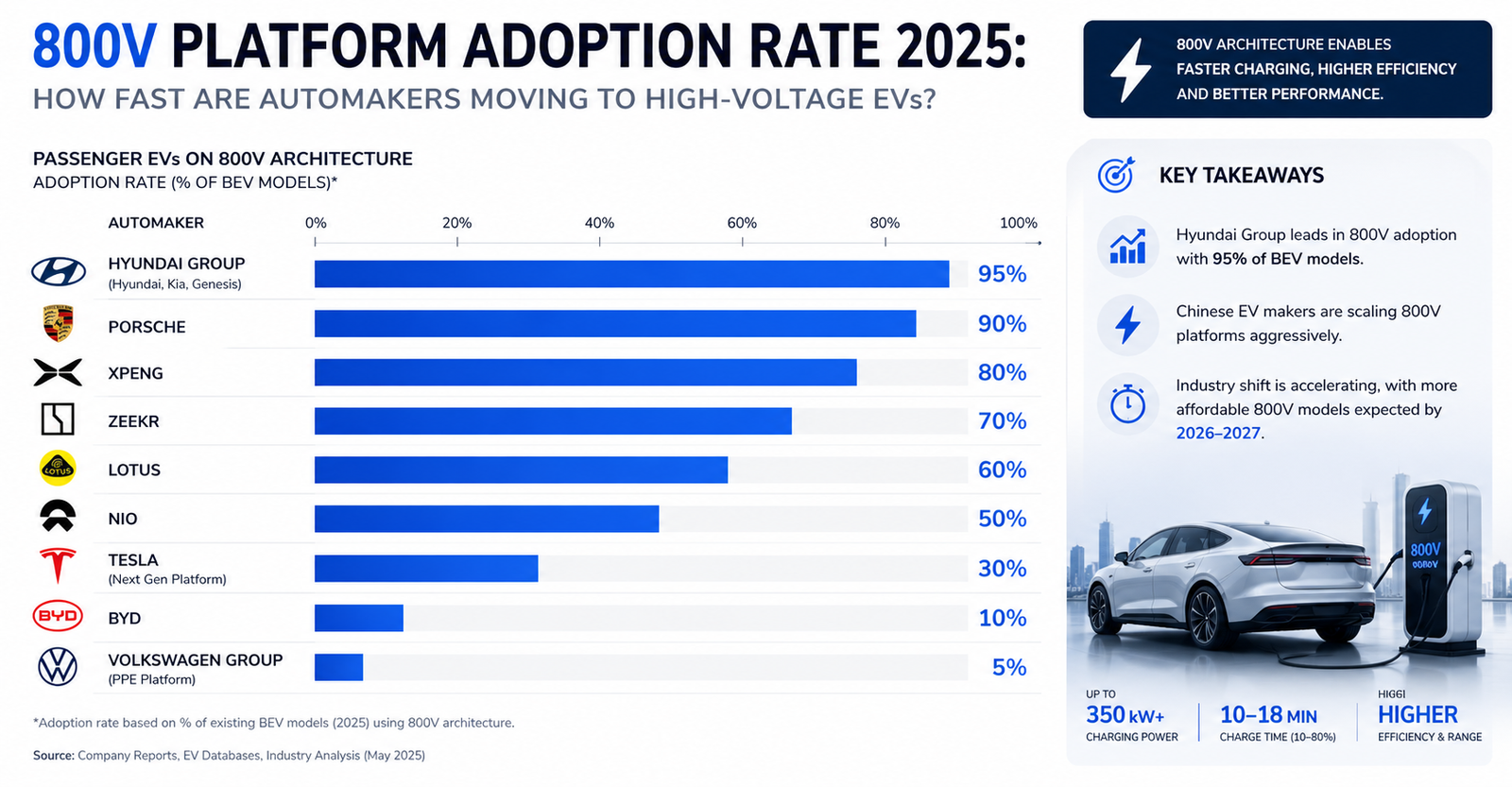
The 800V platform adoption rate 2025 has become an important topic in the electric vehicle industry because it shows how quickly automakers are moving toward faster charging and more efficient high-voltage systems. A few years ago, 800V EV architecture was mostly found in premium models such as the Porsche Taycan, Hyundai Ioniq 5, Kia EV6, and Lucid Air. Now, the technology is starting to appear in more models, especially in China, where competition in the new energy vehicle market is moving very fast.
Still, it is important to keep the trend in perspective. 800V platforms are growing, but they are not yet the global standard. Many electric vehicles still use 400V platforms because they are cheaper, simpler, and good enough for everyday driving. The move to 800V architecture is real, but adoption is uneven across regions, price segments, and charging networks.
800V Platform Adoption Rate 2025: The Quick Answer
The 800V platform adoption rate in 2025 is rising quickly, but it depends heavily on the market.
In China, reports point to stronger adoption than in most other regions. Chinese passenger EVs using 800V systems reportedly reached about 6.9% penetration in 2024, with projections around 9.5% penetration in 2025 and more than 35% by 2030. That makes China one of the clearest leaders in high-voltage EV adoption.
Globally, the picture is more mixed. 800V EV architecture is still more common in premium, performance, and newer-generation EVs. In the mass market, many automakers continue to rely on 400V systems because they keep vehicle costs lower and work well with existing charging infrastructure.
So the short answer is this: 800V platforms are moving from niche technology toward broader adoption in 2025, but the transition is not happening everywhere at the same speed.
What Is an 800V EV Platform?
An 800V EV platform is an electric vehicle architecture built around a higher-voltage battery and electrical system. Most older EVs use around 400V architecture, while newer high-performance or fast-charging EVs may use 800V architecture or even higher-voltage systems.
The main idea is simple. Higher voltage allows the vehicle to move more power with less current. Lower current can reduce heat, improve efficiency, and allow faster charging when the vehicle is connected to a compatible DC fast charger.
That is why 800V electric vehicle architecture is often discussed alongside:
Ultra-fast charging
High-power DC charging
350 kW charging
Silicon carbide inverters
Battery thermal management
High-voltage battery packs
Power electronics
Shorter charging stops
For drivers, the most noticeable benefit is usually faster charging. For automakers, the benefits can include better efficiency, lighter cables, improved performance, and better thermal control.
Why Automakers Are Moving Toward 800V
Automakers are interested in 800V platforms because EV buyers care about charging time. Range still matters, but charging speed has become one of the biggest concerns for people considering an electric vehicle.
A car that can recover a large amount of range in 15 to 20 minutes feels more practical for road trips than one that needs a much longer charging stop. That is where 800V architecture can help.
The main advantages include:
Faster charging when paired with the right charger
Lower heat buildup because less current is needed
Better charging efficiency
Improved high-power performance
Potentially lighter cables and components
Better long-distance driving convenience
This does not mean every 800V EV automatically charges faster than every 400V EV. Battery chemistry, cooling, charging curve, charger power, software, and pack design all matter. But in general, 800V systems give automakers more room to build fast-charging vehicles.
800V vs 400V EV Architecture
The comparison between 800V and 400V EV architecture is one of the main reasons this topic gets attention.
A 400V platform is still common and works well for many electric cars. It is proven, cost-effective, and compatible with a wide range of charging stations. For everyday commuting, home charging, and moderate DC fast charging, a 400V system can be more than enough.
An 800V platform is better suited for vehicles where charging speed, efficiency, and performance are priorities. It is especially useful for long-range EVs, premium EVs, performance cars, and vehicles designed for frequent fast charging.
The tradeoff is cost. 800V systems require more advanced components, including high-voltage wiring, inverters, converters, contactors, battery systems, and safety designs. That can make the vehicle more expensive to build.
This is why adoption is faster in premium vehicles and slower in low-cost EVs.
How Fast Is 800V Adoption Growing in 2025?
The adoption of 800V EV platforms is accelerating, but there are two different ways to look at the data.
One is actual vehicle penetration: how many EVs sold use 800V architecture.
The other is market size: how much revenue is generated by 800V architecture, components, power electronics, and related systems.
Those are not the same thing.
Market reports may show strong growth in the 800V electric vehicle architecture market, but that does not mean the same percentage of EVs already use 800V systems. A market can grow quickly because high-voltage components are expensive, more models are launching, and supply chains are scaling.
In terms of real vehicle adoption, China gives one of the clearest signals. The reported move from 6.9% penetration in 2024 to a projected 9.5% in 2025 shows that adoption is no longer limited to a handful of luxury vehicles. It is moving into more competitive price bands.
Globally, however, 800V architecture remains a minority of EV sales in 2025. The trend is upward, but the majority of EVs still run on 400V platforms.
Why China Is Moving Faster
China is one of the most important markets for 800V platform adoption because its EV industry is extremely competitive. Automakers are fighting on price, charging speed, range, technology, and features. That pressure pushes companies to introduce high-voltage platforms faster.
Chinese brands are also moving 800V architecture into more affordable segments. Reports show that the number of Chinese passenger EV models using 800V systems has grown sharply, from a small group in 2022 to more than 70 models by mid-2025.
That matters because adoption does not become mainstream until the technology moves beyond expensive flagship models. When 800V platforms appear in lower-price EVs, adoption can rise much faster.
Brands connected to this broader shift include BYD, Xiaomi, Leapmotor, XPeng, Zeekr, and other Chinese EV makers. These companies are using high-voltage charging as a way to stand out in a crowded market.
Which Automakers Are Leading the Shift?
Several automakers are already strongly associated with 800V EV architecture.
Porsche helped make the technology famous with the Porsche Taycan, one of the earliest premium EVs to push high-voltage fast charging into public view.
Hyundai and Kia brought 800V capability to a broader audience through the Hyundai Ioniq 5, Hyundai Ioniq 6, Kia EV6, and Kia EV9. Their E-GMP platform helped show that fast-charging architecture did not have to be limited only to ultra-luxury cars.
Lucid uses advanced high-voltage engineering in models such as the Lucid Air and Lucid Gravity, focusing on efficiency, range, and performance.
Audi has used 800V-related technology through models linked to performance EV development, including the Audi e-tron GT.
Genesis, Lotus, Xiaomi, BYD, XPeng, Zeekr, and Leapmotor are also part of the wider high-voltage EV conversation.
Meanwhile, companies such as Tesla, Ford, General Motors, Volkswagen, BMW, Nissan, Rivian, and Polestar are taking different paths depending on model strategy, cost targets, charging standards, and platform timing.
Why 800V Is Still Not Universal
Even with strong momentum, 800V platforms are not yet universal in 2025.
The biggest reason is cost. Higher-voltage systems require more advanced parts. Automakers need suitable battery packs, inverters, DC-DC converters, on-board chargers, contactors, thermal systems, and safety designs. These components add cost and complexity.
Another issue is charging infrastructure. An 800V EV shows its biggest advantage when connected to a compatible ultra-fast DC charger. If the charger is limited, the car may not reach its best charging speed.
There is also the question of mass-market value. For a lower-cost city EV, 400V architecture may be enough. Many drivers charge at home overnight and rarely need ultra-fast charging. For them, a cheaper 400V EV may make more sense than paying extra for 800V capability.
That is why adoption will likely remain uneven for several years.
The Charging Infrastructure Gap
The success of 800V EV architecture depends heavily on charging networks.
A vehicle may be capable of very fast charging, but the driver still needs access to a charger that can deliver enough power. If high-power chargers are scarce, unreliable, or crowded, the real-world benefit becomes smaller.
This is especially important outside China, where infrastructure rollout can vary widely by country, state, city, and highway corridor.
Charging standards also matter. In North America, the industry is moving through a transition involving NACS, CCS, and access to the Tesla Supercharger network. That shift creates both opportunity and uncertainty.
For 800V adoption to grow faster, drivers need more:
350 kW DC fast chargers
Reliable high-power charging stations
Better highway charging coverage
Improved charger uptime
Compatible connectors
Clear pricing and payment systems
Without that infrastructure, automakers may hesitate to make 800V standard on lower-cost EVs.
What 800V Means for EV Buyers
For EV buyers, 800V architecture is useful, but it should not be the only reason to choose a car.
It matters most if you take long trips, rely on public fast charging, or want the shortest possible charging stops. If you mostly charge at home and drive locally, the difference between 400V and 800V may not matter as much in daily life.
When comparing EVs, buyers should look at:
Real-world charging speed
Charging curve from 10 to 80 percent
Battery size and range
Efficiency
Charger compatibility
Local fast-charging access
Home charging needs
Price difference
Warranty and reliability
Thermal management
An 800V platform is a strong feature, but a well-designed 400V EV can still be a good choice for many drivers.
Why 800V Helps With Fast Charging
Fast charging is about moving energy into the battery quickly. Power is measured in kilowatts, and power depends on voltage and current.
With higher voltage, the system can deliver high power with lower current. Lower current reduces heat and electrical losses, which can help with charging efficiency and component durability.
This is why 800V platforms are often linked with 350 kW charging and shorter charging stops. The system is better suited to moving large amounts of energy quickly.
However, the vehicle still needs a battery pack that can accept high power without overheating or degrading too quickly. That is where battery management systems, cooling, chemistry, and software become important.
Silicon Carbide and Power Electronics
The rise of 800V EV platforms is also tied to better power electronics.
Many high-voltage EVs use silicon carbide, or SiC power electronics, because they can improve efficiency and handle high voltage well. Silicon carbide inverters can reduce switching losses, improve thermal performance, and support more efficient power delivery.
This matters because an EV is not just a battery and motor. It is a full electrical system, including:
Inverter
DC-DC converter
On-board charger
Battery management system
Electric drive unit
High-voltage cable
Thermal management system
Charging connector
The growth of 800V architecture depends on the whole supply chain becoming cheaper, more reliable, and easier to scale.
Why Market Reports Sound So Optimistic
Market reports on 800V electric vehicle architecture often show very high growth rates. That optimism comes from several factors.
First, the technology is starting from a relatively small base. When a market is small, growth percentages can look very large.
Second, more automakers are launching high-voltage platforms. Every new model adds demand for batteries, inverters, converters, cables, connectors, and chargers.
Third, ultra-fast charging infrastructure is expanding, which makes high-voltage EVs more practical.
Fourth, competition in China is pushing faster adoption and lower price points.
Still, market growth should not be confused with total market dominance. 800V architecture can grow quickly and still remain a minority of global EV sales in 2025.
What Slows 800V Adoption?
Several barriers can slow the shift from 400V to 800V platforms.
Cost is the biggest challenge. High-voltage parts can be more expensive, especially when supply chains are still scaling.
Charger availability is another major issue. Without enough high-power chargers, buyers may not experience the full benefit.
Compatibility can also matter. Some 800V vehicles need special solutions to charge well on lower-voltage chargers.
Manufacturing scale takes time. Automakers cannot instantly move every model to a new architecture.
Consumer demand is mixed. Some buyers care deeply about fast charging. Others care more about purchase price.
Safety and service training also matter because technicians must be trained to work safely around higher-voltage systems.
These barriers do not stop adoption, but they explain why the transition will be gradual.
Is 800V Becoming the New Standard?
800V architecture is becoming more important, but it is not yet the universal EV standard in 2025.
For premium EVs, performance EVs, and long-range models, 800V is likely to become increasingly common. It gives automakers a clear way to improve charging speed and performance.
For lower-cost EVs, the picture is less clear. Many buyers in that segment may prefer affordability over ultra-fast charging. A 400V platform can still deliver a practical and reliable EV at a lower price.
The likely future is not one sudden switch. Instead, the market will probably split for a while:
Premium and long-range EVs move faster toward 800V
Mainstream EVs adopt it more gradually
Budget EVs may stay with 400V longer
China moves faster than many other regions
Charging infrastructure influences adoption speed
By 2030, 800V platforms may be much more common, especially if costs fall and charging networks improve.
What Automakers Need to Make 800V Mainstream
For 800V platform adoption to move from early growth to mainstream use, automakers need several things to happen at once.
They need cheaper high-voltage components.
They need more reliable ultra-fast charging infrastructure.
They need battery packs that can handle high charging rates.
They need better supply chain scale.
They need consumers to value fast charging enough to pay for it.
They need service networks trained for high-voltage systems.
The technology is ready in many ways, but the business case must work across more price points.
That is why China’s progress matters. If Chinese automakers prove that 800V systems can be used in lower-cost models, global competitors may feel pressure to follow.
Final Takeaway on 800V Platform Adoption Rate 2025
The 800V platform adoption rate 2025 shows a market in transition. 800V EV architecture is growing quickly, especially in China, where penetration is projected near 9.5% in 2025 after reaching about 6.9% in 2024. Forecasts suggest much higher adoption by 2030, especially as more models enter lower price ranges.
Globally, though, 800V platforms are still not the majority. Many EVs continue to use 400V architecture, especially in affordable and mass-market segments. The reasons are practical: cost, infrastructure, compatibility, and consumer priorities.
For automakers, 800V architecture is a way to offer faster charging, better efficiency, and stronger performance. For buyers, it can make long-distance EV travel easier if the right chargers are available.
The clearest way to understand the trend is this: 800V platforms are moving beyond premium EVs in 2025, but adoption is still uneven. China is leading the shift, premium automakers are pushing the technology forward, and the rest of the market is watching cost and charging infrastructure before making it standard.