 By Admin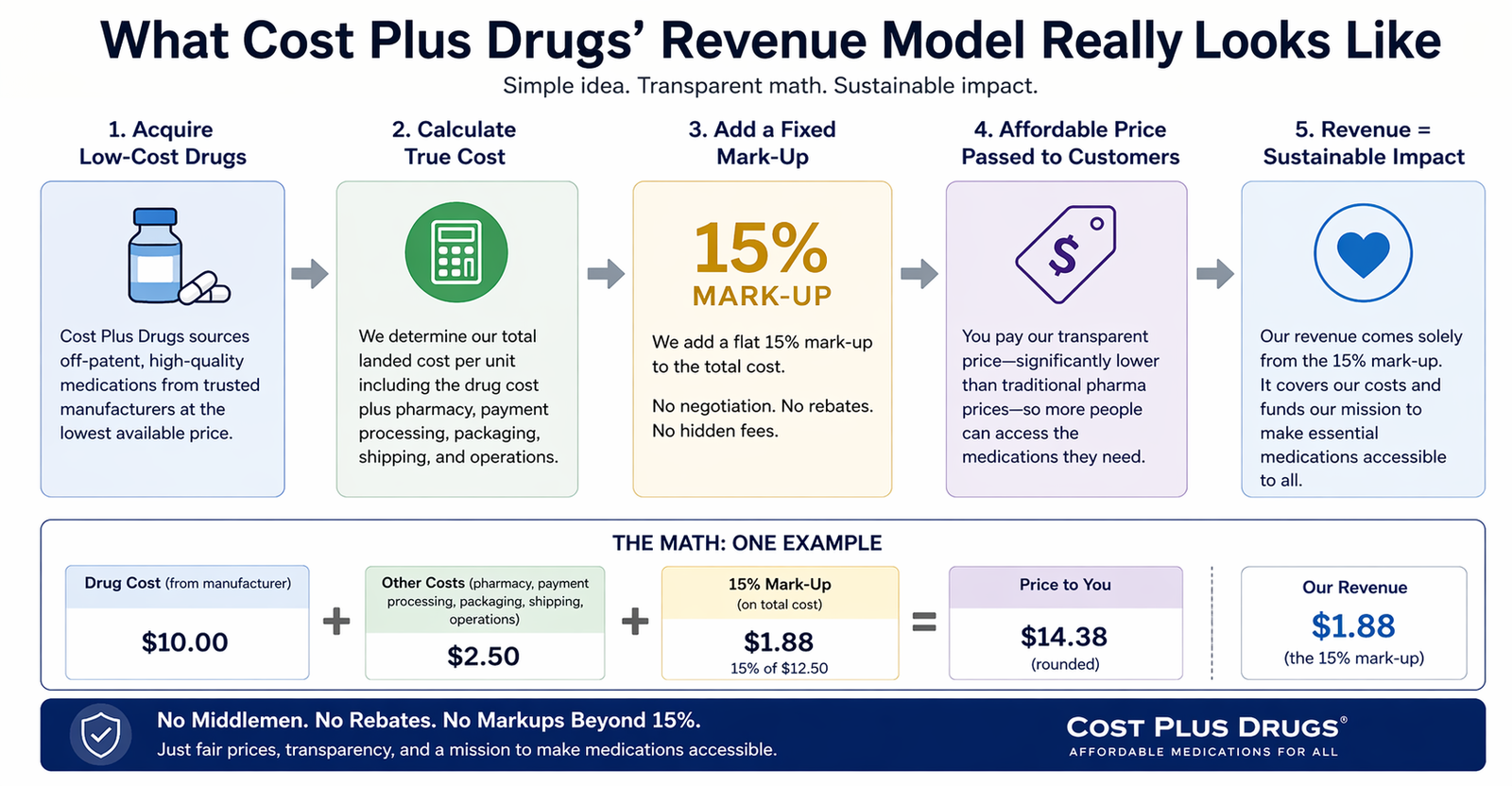
If you search for Cost Plus Drugs revenue, it is easy to assume there must be one clean number that explains the business. There really is not, at least not in the public sources people usually find first. What is much easier to see is the company’s model: a transparent pharmacy business with a fixed markup, plus a growing set of revenue streams beyond simple direct-to-consumer prescription sales. That is the more useful way to understand how Mark Cuban Cost Plus Drug Company actually works.
The core of the business is still the cost-plus formula
At the center of Cost Plus Drugs is a very simple pricing structure. Mark Cuban has repeatedly described it as the company showing what it paid for the drug, then adding a 15% markup, a $5 pharmacy fee or pharmacist review fee, and shipping. TechCrunch describes the same direct-to-consumer formula as manufacturer cost plus a 15% markup, a $5 pharmacy fee, and shipping, while Penn LDI quotes Cuban saying the company publishes those prices online. That transparency is not just branding. It is the actual foundation of the business model.
That matters because the company was built to attack one of the biggest pain points in U.S. healthcare: opaque pricing shaped by pharmacy benefit managers, or PBMs. TechCrunch says Cuban launched Cost Plus Drugs in 2022 to pull back the curtain on drug pricing and sell based on cost instead of “price to market.” Penn LDI frames the same idea as a structural workaround to the PBM-driven drug supply chain. So from day one, the revenue model was never about squeezing the highest possible margin out of each prescription. It was about using lower, visible margins to win trust and volume.
That transparency is powerful, but it does not automatically mean high margins
This is where the business gets more interesting. A transparent markup sounds simple, but it also limits how much money the company can make on each direct mail-order prescription. TechCrunch says the direct patient-shipping side of the business has razor-thin margins. That is a key point, because it tells you the website pharmacy by itself is probably not the whole financial story. If a company is deliberately keeping direct prescription pricing lean, it has to find scale, efficiency, or additional revenue channels elsewhere.
That helps explain why Cost Plus Drugs has been expanding outward instead of staying a narrow online pharmacy. The low-price consumer model gets attention and builds trust, but the wider company seems designed to make money through a broader healthcare distribution strategy, not just through one website checkout flow. That is the difference between a pricing idea and a business model.
The business now reaches beyond direct-to-consumer prescriptions
One of the clearest signals from the reporting is that Cost Plus Drugs is building multiple paths to revenue. Fierce Healthcare says the company now sells about 2,500 medications, including some brand-name drugs, and works with a growing list of health systems. It notes that Community Health Systems expanded its partnership with Cost Plus Drugs to all 71 affiliated hospitals, and that the company also works with at least four PBMs, including Rightway, EmsanaRx, RxPreferred Benefits, and PCA Rx.
Those details matter because they show the company is not only serving individual patients. It is also building business-to-business relationships across hospitals, benefit managers, insurers, and partners in the broader drug supply chain. Fierce Healthcare also says the company partnered with Coherus BioSciences to sell a biosimilar version of Humira, and that Blue Shield of California planned to partner with Cost Plus Drug Company as part of a new drug-benefits model, following Capital Blue. That kind of expansion can create larger, more scalable revenue opportunities than mail-order prescriptions alone.
Manufacturing looks like one of the most important pieces of the revenue puzzle
If there is one part of the model that seems especially important financially, it is manufacturing. TechCrunch says Cost Plus Drugs has a manufacturing plant in Dallas and that drug manufacturing is more profitable than shipping drugs directly to patients. That is a very important clue about the economics of the business. It suggests the company is not depending only on thin-margin pharmacy sales forever. It is trying to pair the transparent pharmacy model with higher-value activity further up the chain.
Penn LDI adds more context here. It says the company opened its own plant in Dallas to make generic medications and that Cuban described it as capable of producing 2 million vials of sterile injectables. Fierce Healthcare similarly reports that the company now manufactures its own generic medications and drugs in short supply out of a 22,000-square-foot Dallas facility. Put together, those details make the model look less like “cheap drugs on a website” and more like a vertically expanding healthcare business trying to improve margins, supply reliability, and pricing control at the same time.
Public scale signals are available, but a clean revenue number is not
There are still some useful clues about scale. Penn LDI, citing a Forbes profile, says the company had grown to 2,200 drugs sold directly to patients and offered prescriptions to more than 2 million members. The same page quotes Cuban saying the company has now served millions of customers. Those numbers help show that this is not a tiny niche operation. There is real volume moving through the platform.
But when people go looking for exact revenue, the public web gets messy fast. Growjo currently estimates Mark Cuban Cost Plus Drug Company PBC at $23.1 million in annual revenue, while ZoomInfo lists Cost Plus Drugs at < $5 million in revenue. Those figures are so far apart that they are best treated as rough directory estimates, not as a reliable answer to the question. In other words, the public internet makes the company’s size look fuzzy, while the operating model itself is much easier to understand.
So what does the revenue model really look like?
The clearest answer is that Cost Plus Drugs appears to run on three layers at once. First, there is the transparent consumer pharmacy model built on cost plus a fixed markup and fees. Second, there are larger distribution and partnership channels with hospitals, insurers, pharmacy benefit managers, and drug makers. Third, there is manufacturing, which reporting suggests carries better economics than direct mail-order pharmacy alone.That is why the business is more interesting than the keyword makes it sound. Cost Plus Drugs is not just a low-price pharmacy trying to survive on a tiny markup. It is building a broader healthcare operation around transparent pricing, distribution relationships, and in-house manufacturing. So when people ask about revenue, the smarter answer is not a shaky number pulled from a directory page. It is this: Cost Plus Drugs makes money through a lean cost-plus pharmacy model, but its longer-term economic strength likely depends on scale, partnerships, and higher-margin activities like manufacturing.