 By Admin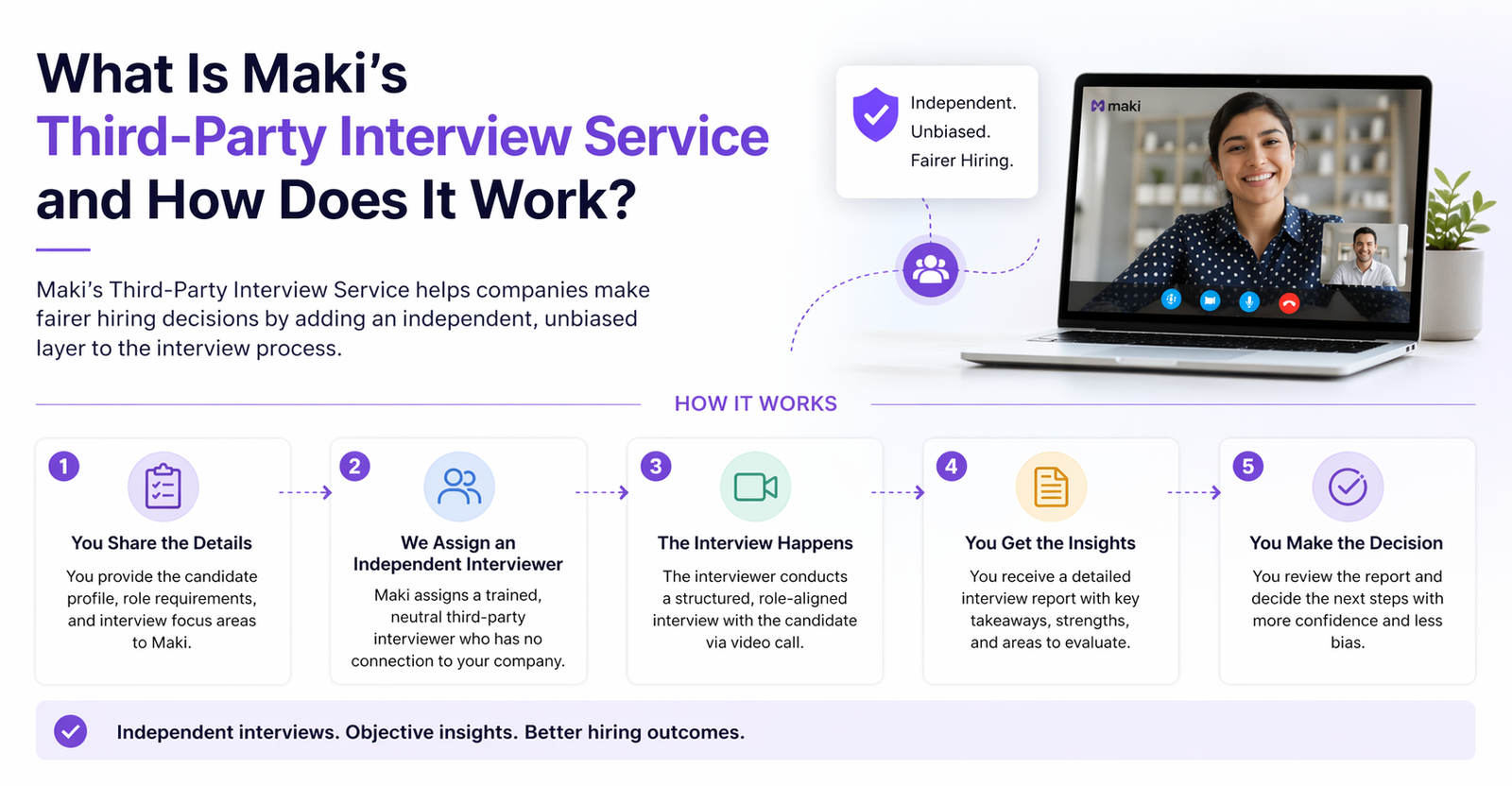
If you came across Maki and wondered whether it is a classic third-party interview service, the short answer is not exactly. Maki is better understood as an AI hiring platform that can take over a big part of the interviewing, screening, and assessment work that employers usually handle manually. On its site, Maki describes itself as “the intelligence running your hiring, end to end,” with AI agents covering screening and in-depth assessment across the workflow.
That difference matters. A traditional third-party interview service usually means outside recruiters or trained interviewers are conducting interviews for a company. Maki is not mainly selling human interviewers. It is selling a system that runs structured hiring steps through AI agents, then feeds the results back into the employer’s process. That is why the product feels like a third-party interview layer, even though it is really software embedded inside the company’s hiring stack.
Maki works like an external interview and assessment engine
The easiest way to understand Maki is to think of it as an outside engine plugged into the hiring workflow. On the official site, Maki says its agents handle screening and assessment, while its Greenhouse integration page says the platform can support the hiring journey from sourcing and screening to interviewing and selection. In practice, that means the employer does not need to personally run every early-stage screening step by hand. Maki takes on a lot of that work through automated interviews, structured assessments, and scoring.
This is where the “third-party” angle comes from. Even though the company owns the hiring decision, part of the candidate evaluation is happening through an outside platform rather than through a recruiter’s live call or an unstructured internal interview. That makes Maki feel similar to a third-party interview service from the candidate side, especially in the early funnel. But behind the scenes, it is still an employer-controlled process powered by technology, not a traditional outsourced interview agency.
The platform uses different AI agents for different parts of hiring
One of the more useful things about Maki is that it breaks the process into distinct agents instead of treating hiring as one generic chatbot task. On its platform overview, Maki says Shiro and Mochi handle screening, while Ken is used for deeper assessment. The site describes Shiro as a skills assessment tool, Mochi as an adaptive voice and web screening agent, and Ken as a structured assessment tool for later-stage or higher-stakes hiring.
That setup helps explain how the service works in practice. A candidate might first go through screening questions or a voice-based interaction that checks fit, communication, or role-related ability. Later, they may be given a more structured, evidence-based assessment that digs deeper into skills and potential. According to Maki, those evaluations are designed to be traceable, explainable, and consistent, which is important for employers trying to reduce guesswork and make hiring decisions in a more standardized way.
Screening is one of the biggest pieces of the value
For many employers, especially those hiring at scale, the first big problem is volume. Too many applicants, too little time, and too much inconsistency in how people get filtered. Maki addresses that directly. Its site says the screening agents are built to “turn volume into clarity” and can screen every applicant at scale using psychometrically validated assessments along with adaptive voice and web interviews. The company also says those signals are bias-mitigated and auditable end to end.
That means the platform is not just asking a few simple knockout questions. It is trying to turn screening into a structured evaluation step. For employers, that is appealing because early-stage hiring is where teams often lose time and where inconsistent judgment tends to creep in. For candidates, it means the first interaction may feel more like a guided digital assessment than a casual recruiter call.
It fits into existing hiring systems instead of sitting off to the side
A big part of how Maki works is integration. On the official site, Maki says it syncs with ATS and HRIS systems and highlights connections with Greenhouse, iCIMS, SAP SuccessFactors, Eightfold, Cornerstone, and Workday. That tells you the product is built to fit into existing hiring infrastructure, not replace everything around it.
The Greenhouse Support documentation makes this concrete. It says employers can add a Maki assessment as an interview stage inside Greenhouse Recruiting, send the test to candidates from there, track status inside Greenhouse, and then open the submitted results in the Maki application. That workflow is one of the clearest proofs that Maki acts like a third-party interviewing and assessment layer embedded inside an employer’s normal recruiting process.
The “service” side becomes even clearer in RPO
If you want the strongest version of Maki as a true third-party interview service, the best example is its partnership with Hudson Talent Solutions. HRTechEdge reports that Hudson is using Maki People inside its global RPO delivery model to give clients structured, real-time candidate insights across the whole funnel, from application to final selection. The article says Maki’s AI agents analyze assessments, interactions, and outcomes so hiring teams can act on structured insights quickly.
This is important because it shows both sides of the story. On its own, Maki is a platform. But when an outsourcing partner such as Hudson Talent Solutions uses it inside managed recruitment operations, it starts to look much more like a full third-party interview service. The employer is then relying on an outside partner plus an outside platform to handle major parts of evaluation and decision support.
Why employers are interested in it
The appeal is not hard to see. Hiring teams want faster cycles, more consistency, and less manual work. Maki says its customers use the platform to automate hiring at scale, and its homepage claims outcomes such as 90% automation of the hiring process, 3x faster time-to-hire, and an average reduction in turnover. In a Business Wire release, the company said its agents had been rolled out in more than 50 markets and were delivering 80% automation of screening and interviewing processes, along with a 3x reduction in time-to-hire and a 20% reduction in turnover.
The company also says it has worked with large organizations including H&M, BNP Paribas, PwC, Deloitte, FIFA, Abercrombie, and Capgemini. Whether a company is hiring frontline workers, early-career talent, or more specialized roles, the sales pitch is basically the same: let the system handle repetitive hiring work more consistently so recruiters can focus on the decisions and conversations that matter most.
What candidates should expect from the experience
From the candidate side, Maki may feel different from a standard interview process. Business Wire says candidates can experience AI-led interactions through voice, video, or text that adapt to their profiles, while the official site describes adaptive voice and web interviews as part of screening. So instead of immediately speaking with a recruiter, a candidate may first complete an AI-driven interaction, respond to structured prompts, or take an assessment that is later reviewed through the employer’s workflow.
That does not necessarily mean the process is cold or impersonal. Maki positions the platform as a way to keep candidates engaged while giving employers more consistent signals. Still, it does mean candidates should be ready for a more structured and technology-led first step than they might expect from a traditional interview process.
So, is Maki a third-party interview service?
The most accurate answer is yes, in effect, but not in the old-fashioned sense. Maki is not mainly a human interview outsourcing firm. It is an AI hiring platform that performs many of the same functions a third-party interview service might perform, especially in screening, assessment, and structured early-stage interviewing. It works by plugging into systems like Greenhouse, running candidate evaluations through AI agents, and sending the results back into the employer’s hiring flow. In some cases, such as the Hudson Talent Solutions partnership, it can also sit inside a broader outsourced hiring model.That is what makes Maki interesting. It is not just another recruiting tool, and it is not exactly a traditional outside interview vendor either. It sits in the middle, acting as a third-party intelligence and interview layer that helps employers scale hiring with more structure, more speed, and more consistency.