 By Admin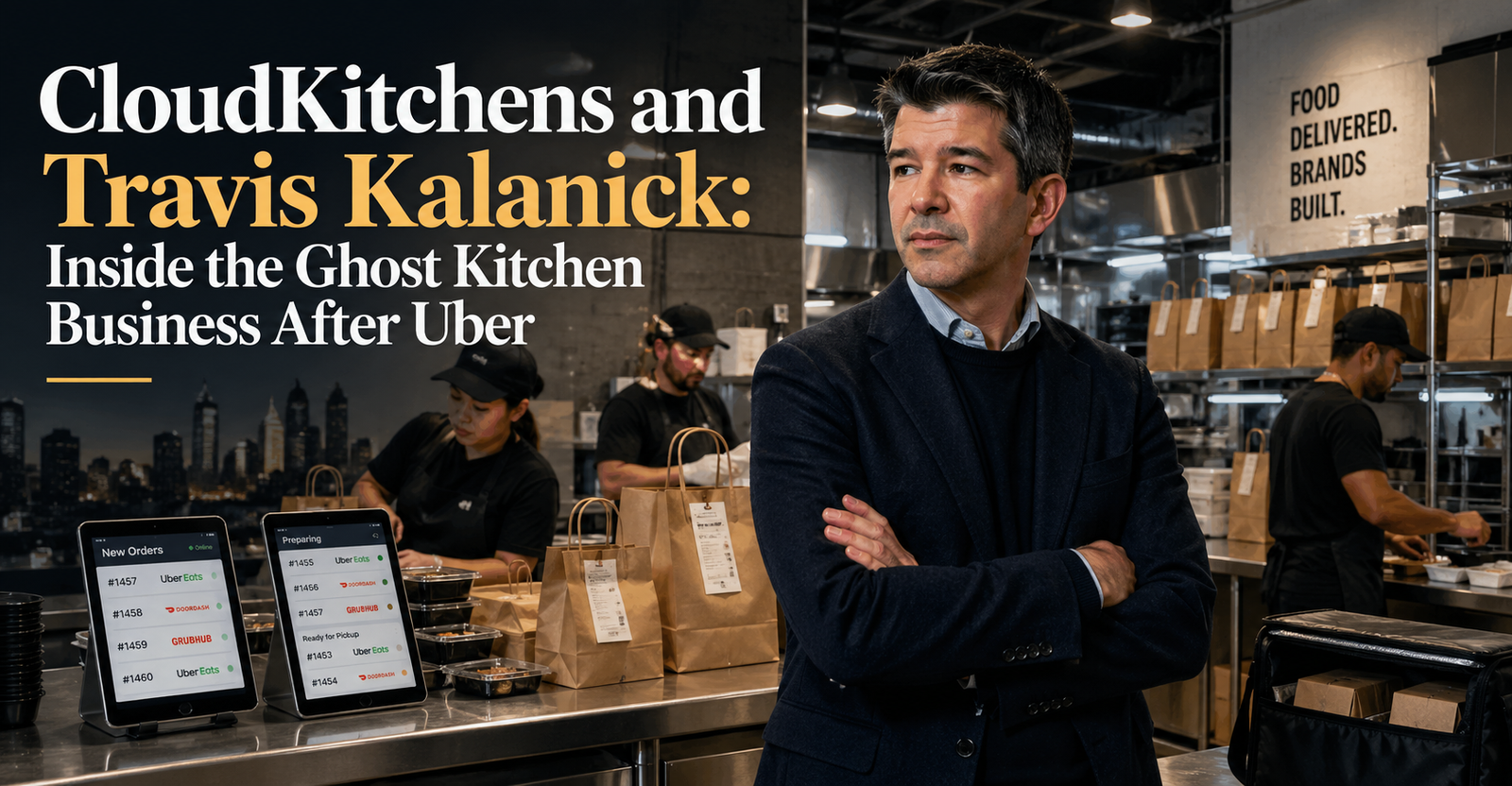
After leaving Uber, Travis Kalanick did not disappear from the startup world. He moved into a different kind of logistics business, one built around food, real estate, software, and delivery. That business became widely known as CloudKitchens.
At first, the idea sounded simple. Instead of building traditional restaurants with dining rooms, expensive storefronts, and heavy front-of-house costs, CloudKitchens offered commercial kitchen spaces designed for delivery and takeout. Restaurants could rent kitchen space, prepare food, and sell through delivery apps or direct online channels.
But CloudKitchens was never only about kitchens. Under Travis Kalanick, it became part of a larger system tied to City Storage Systems, Otter, Lab37, real estate, restaurant software, automation, and now Atoms, a robotics-focused company. CloudKitchens describes its own offering as fully built commercial kitchens optimized for delivery, takeout, and food production, allowing businesses to expand at lower cost than traditional buildouts.
That is what makes the story interesting. CloudKitchens is not just a ghost kitchen company. It is Kalanick’s attempt to build infrastructure for the next version of food delivery.
What Is CloudKitchens?
CloudKitchens is a ghost kitchen and virtual restaurant company. It provides kitchen spaces for restaurants, food entrepreneurs, catering businesses, meal prep companies, and delivery-focused food brands.
A ghost kitchen is a kitchen built for delivery rather than dine-in customers. There may be no visible restaurant, no tables, no waiters, and no customer-facing storefront. The food is prepared in the kitchen and then handed off to delivery drivers or picked up by customers.
The company is based in Los Angeles and operates under City Storage Systems LLC, also called CSS. Public company profiles describe CloudKitchens as a business that combines software, real estate, and virtual restaurant services. The company was founded in 2016 by Diego Berdakin and Sky Dayton, before Travis Kalanick later took control through City Storage Systems.
In plain English, CloudKitchens tries to give restaurants the back-end infrastructure they need to sell food online. Instead of spending months building a full restaurant, a food business can rent a kitchen and start serving delivery customers faster.
How Travis Kalanick Became Involved With CloudKitchens
Travis Kalanick is best known as the co-founder and former CEO of Uber. After leaving Uber’s executive role in 2017 and stepping away from the board in 2019, he turned his attention to physical-world infrastructure again, but this time through food and real estate.
In 2018, Kalanick acquired a controlling stake in City Storage Systems for about $150 million and became its CEO. City Storage Systems became the parent company behind CloudKitchens, which focused on turning underused real estate into delivery-focused commercial kitchens.
This move made sense for Kalanick’s style. Uber was built around matching supply and demand in real time. CloudKitchens uses a similar logic, but instead of matching riders and drivers, it tries to connect food demand, kitchen supply, delivery platforms, and real estate.
The connection to Uber Eats is obvious. Kalanick had already seen how quickly food delivery could grow when the ordering layer moved online. CloudKitchens was a bet that the kitchen layer could be rebuilt too.
CloudKitchens Business Model Explained
The CloudKitchens business model sits at the intersection of real estate, food delivery, and software.
The company buys or leases properties that can be converted into kitchen facilities. These may include underused commercial spaces, warehouses, parking-related properties, or other real estate that can support delivery operations. The spaces are then divided into smaller kitchens that restaurants can rent.
A restaurant using CloudKitchens may not need a dining room, expensive street-front location, or large front-of-house team. Instead, it can focus on preparing food for online orders.
The basic model looks like this:
| Part of the Model | How It Works |
| Real estate | CloudKitchens finds or converts spaces into delivery-focused kitchens |
| Kitchen rental | Restaurants rent commercial kitchen space |
| Delivery demand | Orders come through apps like DoorDash, Uber Eats, Grubhub, or direct channels |
| Software | Tools like Otter help manage orders and operations |
| Automation | Divisions like Lab37 explore robotics and food production efficiency |
The promise is attractive. Restaurants can expand into new neighborhoods without building a full restaurant. Food entrepreneurs can test brands with lower upfront costs. Large chains can add delivery capacity without opening another dine-in location.
But the model also has challenges. Delivery margins can be thin. Rent still matters. Labor still matters. Food quality must survive transport. And restaurants often remain dependent on delivery platforms that charge commissions.
City Storage Systems, Otter, and Lab37
To understand CloudKitchens, it helps to understand the wider City Storage Systems ecosystem.
City Storage Systems is the parent company. CloudKitchens provides the kitchen infrastructure. Otter provides software for restaurants. Lab37 focuses on food technology and robotics.
Otter is especially important because restaurants often struggle to manage orders from several platforms at once. A restaurant may receive orders from Uber Eats, DoorDash, Grubhub, direct ordering, and its own website. That can become messy quickly. Otter helps restaurants manage online orders, menus, kitchen workflows, payments, analytics, and other operational tools.
Lab37 adds another layer. Its own site describes it as a subsidiary of City Storage Systems that works with sister companies CloudKitchens, Otter, and Picnic to advance food technology innovation.
Together, these pieces show that CloudKitchens is not only renting kitchens. The larger goal is to build a food infrastructure stack that includes physical space, software, and automation.
Why Travis Kalanick Bet on Ghost Kitchens After Uber
The ghost kitchen idea fits several themes that have followed Travis Kalanick throughout his career.
First, it is about density. Food delivery works better when kitchens are close to customers. The closer the kitchen, the faster the delivery and the better the chance the food arrives in good condition.
Second, it is about logistics. Uber was a logistics company at its core. CloudKitchens also depends on routing, timing, demand, fulfillment, and operational discipline.
Third, it is about underused assets. Uber used privately owned cars. CloudKitchens uses underused real estate and turns it into food production infrastructure.
Fourth, it is about software control. Delivery restaurants need order management, menu tools, analytics, and workflow systems. That is where Otter fits in.
In theory, CloudKitchens gives Kalanick a chance to build something more controlled than Uber. Uber depended on millions of drivers and heavy marketplace incentives. CloudKitchens can control more of the physical infrastructure, software, and kitchen environment.
That does not make the business easy. It just makes it very Kalanick.
Funding, Investors, and Valuation
CloudKitchens attracted major investor attention because the ghost kitchen model looked like a natural extension of the food delivery boom.
The company reportedly received $400 million from Saudi Arabia’s Public Investment Fund, also known as PIF, in 2019. It later raised $850 million in 2021 in a round that included Microsoft. Public profiles say CloudKitchens was valued at about $5 billion in 2019 and an estimated $15 billion by 2021.
Those numbers show how much confidence investors once had in the model. During the delivery boom, ghost kitchens looked like a way to rebuild restaurant infrastructure for a mobile-first world.
But large funding also creates pressure. A capital-intensive company has to keep occupancy high, manage real estate risk, support tenants, and prove that the economics work across many cities. That is much harder than simply opening a few successful locations.
Why CloudKitchens Became Controversial
CloudKitchens has attracted attention not only because of its ambition, but also because of its secrecy and criticism from some restaurant operators.
The company has often operated quietly compared with other food-tech startups. That secrecy made it more interesting to investors and reporters, but it also made the business harder to understand from the outside.
Some criticism has focused on the broader ghost kitchen model. Restaurants may face high delivery platform fees, thin margins, customer acquisition costs, and operational pressure. If a food brand cannot generate enough repeat demand, a lower-cost kitchen still may not save the business.
There have also been complaints from operators around onboarding, support, fees, and software issues. Some of these appear in online forums and should be treated carefully because they are individual claims rather than fully verified reporting. Still, they reflect a real concern: a kitchen is only useful if the operator can run a profitable restaurant inside it.
The bigger challenge is that ghost kitchens are not magic. They reduce some costs, but they do not remove the hard parts of the restaurant business. Food still has to taste good, arrive quickly, price correctly, and stand out in crowded delivery apps.
CloudKitchens and the Cooling of the Ghost Kitchen Boom
The ghost kitchen market grew quickly during the pandemic, when delivery demand surged and dine-in traffic collapsed. But after restaurants reopened and consumer behavior normalized, the market became more complicated.
Some ghost kitchen operators struggled with occupancy, profitability, and tenant churn. The model worked better in some locations than others. In dense cities with strong delivery demand, the idea made more sense. In weaker markets, the economics could be harder.
This is where CloudKitchens has a difficult balancing act. It is partly a real estate company, partly a restaurant services company, and partly a software company. Each part has different risks.
Real estate requires capital. Software requires product quality and support. Restaurants require reliable daily operations. Delivery requires demand density. When all of these work together, the model can be powerful. When one part breaks, the whole system feels the pressure.
CloudKitchens, Atoms, and Kalanick’s Robotics Ambition
The newest chapter in the CloudKitchens story is Atoms.
In March 2026, Travis Kalanick launched Atoms, a robotics-focused company aimed at specialized industrial robots for food, mining, and transport. Reuters reported that Atoms is an expansion and rebranding of City Storage Systems, with divisions called Atoms Food, Atoms Mining, and Atoms Transport.
TechCrunch also reported that CloudKitchens is being rolled into Atoms, which suggests that Kalanick’s ambitions now go beyond ghost kitchens alone.
This matters because it reframes the whole company. CloudKitchens may have started as a kitchen real estate business, but Atoms suggests a broader push into physical AI, robotics, and automation for industries that still depend heavily on manual work.
For food, that could mean automated food preparation, robotic kitchen systems, smarter fulfillment, and lower labor intensity. For mining and transport, the same idea could apply to specialized robots built for specific tasks.
In other words, CloudKitchens may be one piece of a much larger automation strategy.
CloudKitchens vs Uber: Similar Playbook, Different Market
The comparison between CloudKitchens and Uber is unavoidable.
Both businesses deal with physical-world logistics. Both rely on density. Both use software to coordinate messy real-life operations. Both try to unlock underused supply. Both involve Kalanick’s interest in scale, speed, and operational control.
But the markets are very different.
Uber grew by connecting riders with drivers through a marketplace. CloudKitchens has to manage real estate, kitchens, restaurant tenants, food operations, software, delivery apps, and sometimes automation. That makes it more asset-heavy and operationally complex.
The advantage is that CloudKitchens can control more of the environment. The disadvantage is that physical infrastructure takes money, time, maintenance, and constant management.
So while CloudKitchens may share some of Uber’s DNA, it is not simply “Uber for kitchens.” It is closer to a food infrastructure company trying to make delivery restaurants cheaper, faster, and more scalable.
Is CloudKitchens Still a Smart Business Model?
The answer depends on how you look at it.
For restaurants, the model can still make sense if they already have strong demand, a delivery-friendly menu, and a clear customer base. A ghost kitchen can help them expand without the cost of a full storefront.
For new food entrepreneurs, it can be useful, but risky. Lower startup costs do not guarantee sales. A delivery-only brand still needs marketing, reviews, pricing discipline, strong operations, and repeat customers.
For investors, the model is more complicated than it looked during the delivery boom. CloudKitchens has valuable pieces: real estate, software, restaurant infrastructure, automation research, and data. But it also faces high CapEx, tenant churn, vacancy risk, delivery app dependence, and a restaurant industry known for thin margins.
The smartest version of the business may not be kitchens alone. It may be the combination of CloudKitchens, Otter, Lab37, and now Atoms. If Kalanick can connect kitchen infrastructure with restaurant software and robotics, the company could become more than a ghost kitchen landlord.
Final Takeaway
CloudKitchens became Travis Kalanick’s biggest business move after Uber, but it is not just a story about ghost kitchens. It is a story about food infrastructure, delivery demand, underused real estate, restaurant software, automation, and Kalanick’s continued interest in rebuilding physical-world industries with technology.
The basic idea is easy to understand: give restaurants delivery-focused kitchens so they can expand faster and cheaper. The deeper ambition is much bigger: create a system where real estate, software, data, robotics, and logistics work together to make food production more efficient.
That ambition explains why CloudKitchens attracted major funding, why it became controversial, and why the launch of Atoms matters. The company’s future may depend less on whether ghost kitchens are trendy and more on whether Kalanick can turn CloudKitchens, Otter, Lab37, and Atoms into a true software-driven food and robotics infrastructure platform.
For now, CloudKitchens remains one of the most interesting post-Uber experiments in food tech. It has big potential, real risks, and a founder who is clearly still chasing large, complicated markets.