 By Admin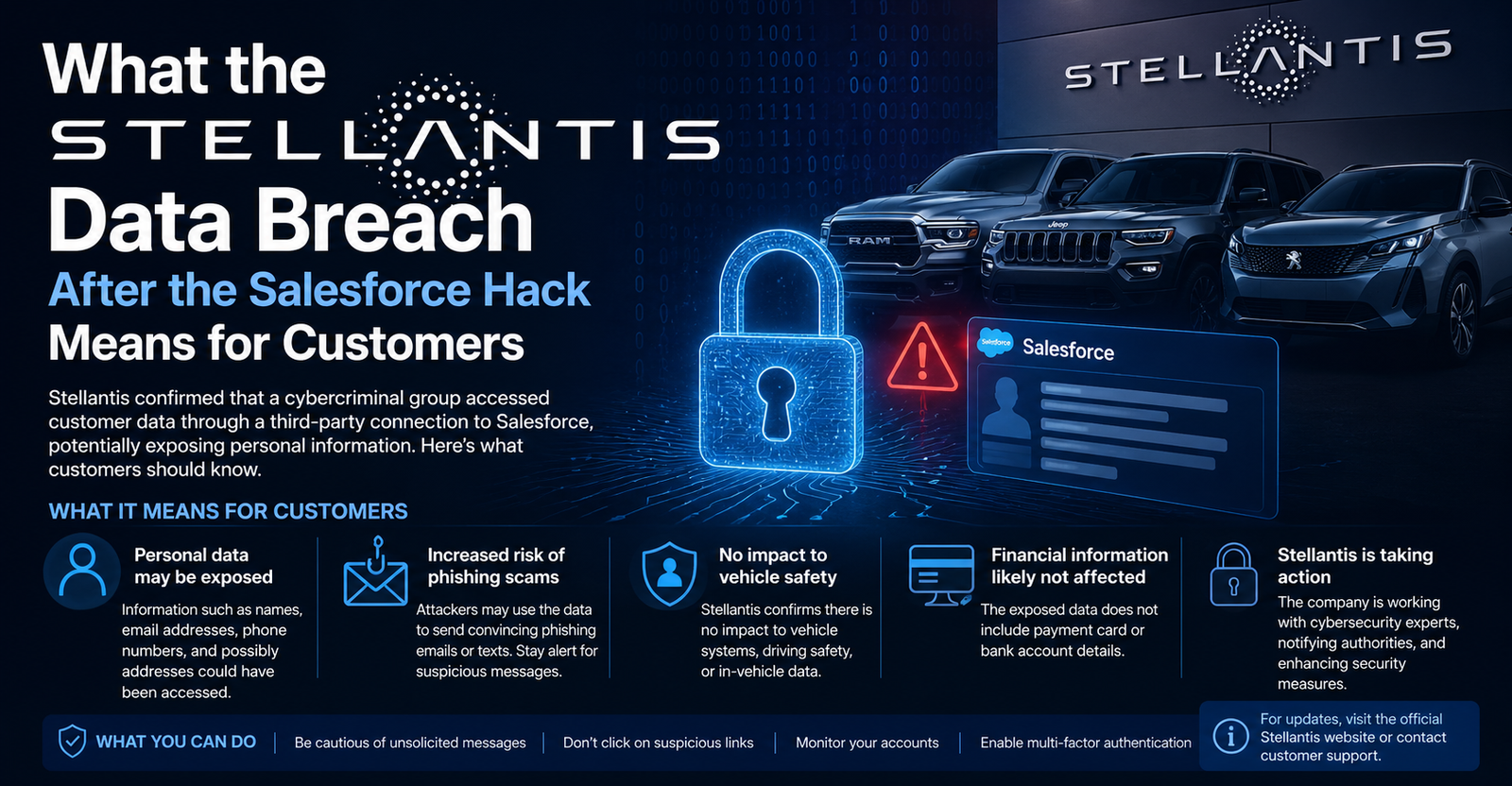
What Happened in the Stellantis Data Breach
Stellantis confirmed a cybersecurity incident involving a third-party service provider used for its North American customer service operations. The company said the incident exposed basic customer contact information, but not financial information or other highly sensitive personal data. Stellantis also said it activated its incident response process, notified authorities, and began informing affected customers directly.
That matters because Stellantis is not a small company. It is the automaker behind major brands such as Jeep, Chrysler, Dodge, Ram, Fiat, Peugeot, Citroën, Opel, and Maserati. A breach involving customer service data can affect many people, even if the exposed information is limited.
The incident became more widely discussed because cybersecurity reports linked it to a broader wave of Salesforce-related data theft attacks. Some headlines called it a Salesforce hack, but the full picture is more specific. The issue appears connected to third-party tools, integrations, and stolen access tokens used to reach company Salesforce environments, not a simple breach of the core Salesforce platform itself.
What Customer Information Was Exposed
According to public reporting, the exposed information was described as basic customer contact information. That usually means details such as names, email addresses, phone numbers, mailing addresses, or similar contact fields, although Stellantis did not publicly confirm every exact data field in the reports reviewed.
The company said the affected platform did not store financial information or other sensitive personal information. That is an important distinction because it suggests the breach did not involve payment card data, bank details, or more severe identity data on that platform.
Still, customers should not ignore the incident. Even “basic” contact data can be useful to criminals. If attackers know someone’s name, phone number, email address, and relationship to a car brand, they can create more believable scam messages.
Was Financial or Sensitive Data Stolen?
Based on Stellantis’ public statement, the company said the compromised provider platform did not store financial information or other sensitive personal information. That means the immediate risk is different from a breach involving credit card numbers, Social Security numbers, or banking data.
But lower-risk does not mean no risk.
A scammer does not always need a credit card number to cause harm. Sometimes they only need enough personal context to make a message feel real. For example, a fake email that mentions Jeep, Chrysler, Ram, or Dodge customer support may feel more convincing if the attacker already has contact details linked to a real customer.
That is why the main customer risk after this breach is likely phishing, smishing, fake support calls, and brand impersonation.
How the Breach Was Linked to Salesforce
Several reports connected the Stellantis incident to a wider Salesforce data theft campaign. BleepingComputer reported that the hacking group ShinyHunters claimed to have stolen more than 18 million Salesforce records connected to Stellantis, while TechCrunch also reported that claim but noted the company did not answer specific questions about the exact number of customers affected.
This is where the wording matters.
Calling it a Salesforce hack can be misleading if readers think the main Salesforce platform itself was directly broken into through a core vulnerability. Google Threat Intelligence Group reported a separate but related campaign in which UNC6395 targeted Salesforce customer instances by abusing compromised OAuth tokens tied to the Salesloft Drift third-party application. Google said that activity did not stem from a vulnerability in the core Salesforce platform.
The easier way to understand it is this: attackers targeted the ecosystem around Salesforce, especially connected apps, third-party integrations, and access tokens. That kind of attack can still expose CRM data, even when the main cloud platform is not the original weak point.
Who ShinyHunters Are and Why They Matter
ShinyHunters is a known cybercriminal group associated with data theft and extortion campaigns. In this case, the group reportedly claimed responsibility for stealing Salesforce records from Stellantis.
The broader campaign has also been discussed alongside names such as Scattered LAPSUS$ Hunters, UNC6040, and UNC6395. These labels can get confusing because different security firms and law enforcement agencies track activity clusters in different ways.
The FBI warned in September 2025 that groups tracked as UNC6040 and UNC6395 had been targeting Salesforce platforms through different methods. According to the FBI, UNC6040 used voice phishing, also known as vishing, while UNC6395 exploited compromised Salesloft Drift OAuth tokens to access Salesforce instances and steal data.
For customers, the group name matters less than the risk. The practical concern is that stolen contact data can be used for scams.
Why Basic Contact Information Can Still Be Dangerous
Many people hear “only contact information” and assume there is nothing to worry about. That is understandable, but it is not always true.
Contact data can make scams more personal. A criminal may send an email pretending to be from Stellantis, a local dealer, a warranty provider, or a customer service team. They might mention a fake vehicle recall, fake service appointment, fake account update, or fake warranty renewal.
The goal may be to get you to click a link, download a file, call a fake support number, or share more sensitive details.
After the incident, Stellantis warned customers to watch for suspicious emails, texts, and calls, especially messages asking them to click links or share personal information.
That is why customers should treat the breach as a phishing risk, even if payment data was not exposed.
What Jeep Chrysler Dodge and Ram Customers Should Watch For
Customers connected to Jeep, Chrysler, Dodge, Ram, Fiat, and other Stellantis brands should be extra careful with unexpected messages.
Watch for emails or texts that claim:
Your vehicle has an urgent recall
Your warranty is expiring immediately
Your customer account needs verification
Your dealer needs updated payment details
Your service appointment was changed
You need to click a link to protect your account
You have a refund or compensation waiting
These messages may look official. They may use brand names, logos, customer service language, or links that look similar to real company pages.
The safest move is simple: do not click links in unexpected messages. Go directly to the official Stellantis brand website, contact your dealer through a known phone number, or use official customer support channels.
Why This Is Bigger Than Stellantis
The Stellantis data breach also highlights a bigger problem in modern business security: customer data often lives inside many connected platforms.
A company may use Salesforce as its CRM, a third-party tool for customer support, an AI chat tool such as Drift, marketing automation software, analytics tools, dealer systems, and other integrations. Each connected tool can become part of the security perimeter.
That is why the Salesloft Drift angle matters. Google Threat Intelligence Group reported that attackers used compromised OAuth tokens linked to Salesloft Drift to access Salesforce customer instances during a data theft campaign.
In plain English, an OAuth token is a digital permission slip. It lets one app connect to another without asking for a password every time. If attackers steal that permission slip, they may be able to access data through the connected app.
That is the kind of risk many companies now face. The weakest point is not always the main system. Sometimes it is the integration connected to the main system.
What Customers Should Do After the Stellantis Breach
If you are a Stellantis customer, the most important step is to stay alert without panicking.
Be cautious with unexpected emails, texts, and calls. Do not click links from messages claiming to be from Jeep, Chrysler, Dodge, Ram, Fiat, or Stellantis unless you are sure they are legitimate.
Check the sender carefully. Scammers often use email addresses that look close to real brand domains but are slightly different.
Do not share personal details through a link sent by text or email. Real companies should not pressure you to hand over sensitive information through an unexpected message.
Contact your dealer or official brand support directly if a message mentions a recall, warranty, payment, or customer account issue.
Use strong passwords and enable multi-factor authentication where available, especially for email accounts. If scammers control your email, they can do far more damage.
Monitor your accounts for unusual activity. Even though Stellantis said financial data was not stored on the affected platform, phishing can lead to further compromise if customers are tricked into sharing information.
What Companies Can Learn From the Stellantis Salesforce Incident
For businesses, the lesson is clear: SaaS security is no longer just about protecting employee passwords.
Companies need to understand every app connected to their Salesforce environment. That includes third-party tools, customer service platforms, AI chat integrations, marketing apps, analytics tools, and any system with access to CRM data.
The FBI warning around UNC6040 and UNC6395 shows that attackers are using more than one route. Some use vishing to trick employees. Others abuse compromised OAuth tokens and third-party integrations.
Businesses should regularly review connected apps, revoke unused tokens, limit permissions, monitor unusual API activity, enforce phishing-resistant MFA, train support teams against social engineering, and treat customer service platforms as high-value systems.
The old idea that CRM data is “just contact data” is outdated. For attackers, contact data is fuel for targeted scams.
What the Stellantis Data Breach Really Means for Customers
The Stellantis data breach appears to be limited to customer contact information, based on the company’s public statement. That is better than a breach involving payment details or sensitive identity data. But it is still serious enough for customers to pay attention.
The real risk is not that every affected customer will face identity theft overnight. The more realistic risk is a wave of convincing phishing, smishing, and fake support messages that use Stellantis brand names to gain trust.
The connection to Salesforce, Salesloft Drift, OAuth tokens, and threat groups such as ShinyHunters, UNC6040, and UNC6395 also shows how complicated modern data breaches have become. A company’s customer data may be exposed through a third-party platform, a connected app, or a stolen token rather than a direct break-in to the main system.
For customers, the best response is caution. Treat unexpected messages carefully, verify requests through official channels, and do not let urgency push you into clicking a suspicious link.
For companies, the message is even bigger: every SaaS integration is now part of the security boundary. The Stellantis Salesforce-linked breach is another reminder that protecting customer data means protecting the entire cloud software chain around it.