 By Admin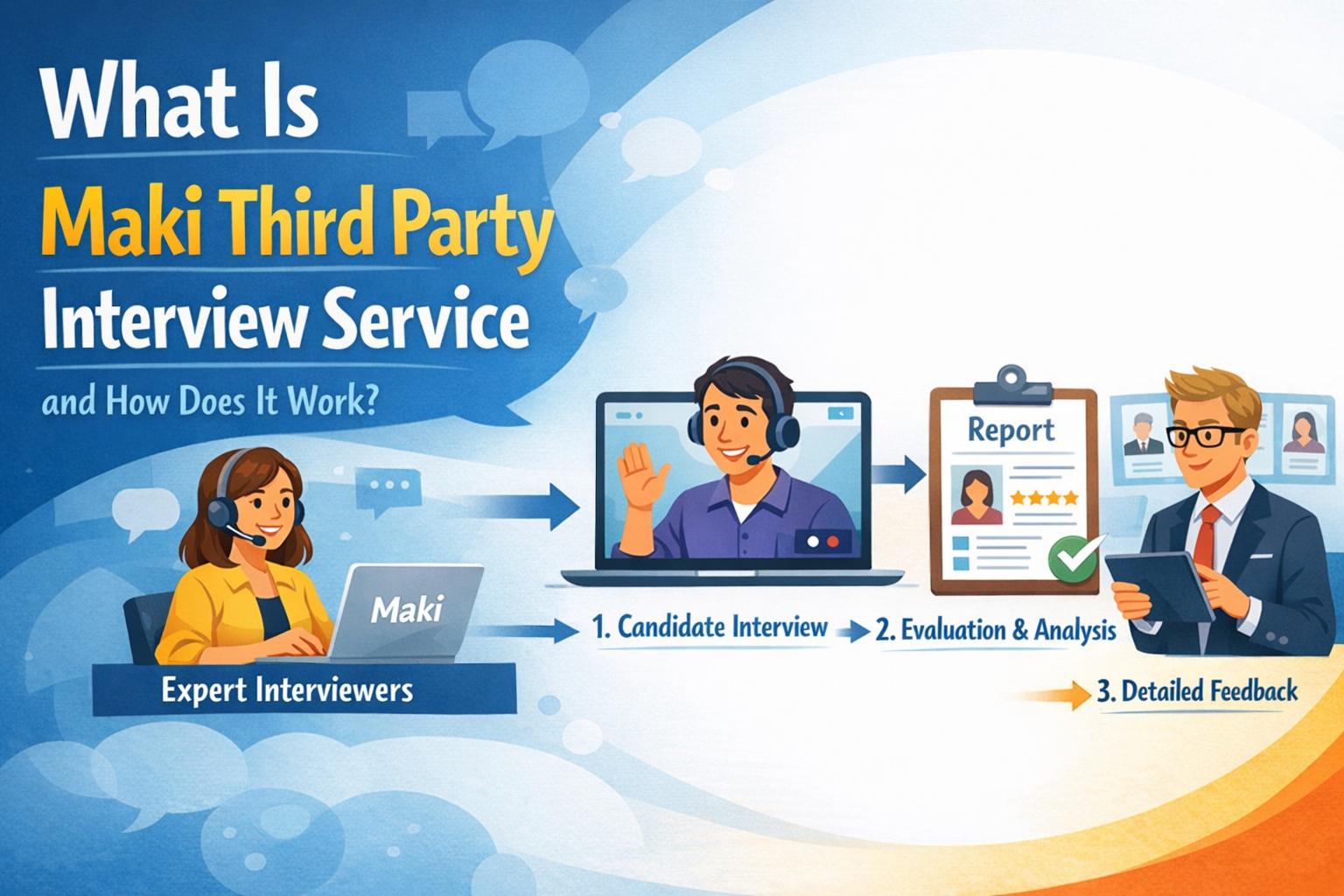
If you have seen Maki pop up during a job application or while researching hiring tools, the first reaction is usually the same. What exactly is this, and why is it sitting between the candidate and the employer? That question is fair, because Maki is not just a scheduling tool or a simple test portal. It is an external AI hiring platform that companies use to screen, assess, and sometimes interview candidates before later hiring stages.
The easiest way to describe it is this: Maki works like an intelligence layer inside the hiring process. On its official site, the company says its AI agents are built to handle different parts of the workflow, with Shiro focused on skill screening, Mochi focused on conversational screening, and Ken focused on deeper, later-stage assessments. The platform is designed to sit alongside an employer’s existing recruiting tools rather than replace them outright.
What Maki actually is
At its core, Maki is a structured hiring and assessment system. The official product overview says it is built for bias-audited hiring at scale, and that its evaluations are grounded in psychometric frameworks covering 400+ skills. The same pages describe the platform as workflow-native, science-grade, and enterprise-ready, which tells you a lot about how the company wants to be understood. It is selling more than automation. It is selling a way to make hiring more standardized, more measurable, and easier to defend.
That positioning matters because a lot of people search this keyword after running into the product in a hiring flow. They are not looking for a venture funding story. They want a direct explanation. In practical terms, Maki is a third-party layer that helps employers evaluate candidates through structured tests, conversational screens, and scored assessments that go beyond a traditional CV review. Both the official site and outside descriptions frame it around evaluating actual skills rather than relying too heavily on resumes alone.
Why it gets called a third party interview service
The phrase third party interview service fits because the employer is not always running the first interaction directly. Instead, a company can bring in Maki as an outside platform to handle early screening or assessment work on its behalf. That might mean a candidate completes a short structured test, joins a branded web interview, or speaks with an AI interviewer before talking to a human recruiter.
This is especially clear with Mochi, which Maki describes as the conversational screening agent that automates the recruiter phone screen. According to the official page, candidates can join by web call or phone call, and the system evaluates things like eligibility, motivation, availability, communication, and basic job-fit signals through structured conversational scoring. That is why the keyword makes sense. Maki is effectively standing in as an outside first-round screening layer.
How Maki fits into the hiring workflow
One of the most useful things in the competitor set is the workflow detail. Maki’s integrations page says the platform works with 30+ ATS systems and lets employers trigger Maki Agents directly from their ATS or HRIS, then see the results where their team already works. The same page lays out a simple process: configure the stage, invite candidates, push progress updates, send results back to the ATS, and optionally enable auto-progression.
The Greenhouse support page turns that into something concrete. It says employers can add Maki as an assessment stage in their interview plans, send the test to candidates, see assessment status directly in Greenhouse Recruiting, and then open the submitted test and results through Maki. That matters because it shows Maki is not just a separate website floating outside the workflow. It is meant to plug directly into a recruiting operation.
Maki’s own integration page also says invitations can be triggered automatically once a candidate reaches the defined stage, and that candidate progress is synced back to the ATS in real time. So from the employer side, the pitch is straightforward: instead of manually handling every top-of-funnel step, the team can let Maki run the repetitive screening work and then review the strongest candidates with more context already in place.
What candidates may experience
For candidates, the experience can feel different from a normal first-round recruiter call, but once you know what Maki is doing, it makes more sense. A candidate may be asked to complete a short skills assessment, respond to structured prompts, or join a web or phone conversation with Mochi. The official product pages say these assessments can cover cognitive, behavioral, technical, and language skills, and they may use formats such as problem solving, situational judgement, coding, audio prompts, and video prompts.
Mochi adds the conversational part. Maki says the system can ask follow-up questions, adapt to a candidate’s answers, and even respond to common role-related questions when the employer has provided approved information in advance. So this is not just a static questionnaire. The product is trying to simulate a structured screening conversation while keeping the scoring consistent.
That said, the broader comparison pages show why some buyers and candidates still look closely at this category. Mokka’s evaluation guide emphasizes concerns like audit trails, fallback modes, standardized prompts, and whether question-level evidence can be reviewed later. Those concerns are useful context because they reflect what serious buyers want from AI-led interviewing tools. They do not just want speed. They want decisions they can explain afterward.
The three main Maki agents
The agent structure is one of the clearest parts of the product. Shiro is the early-funnel screening agent. Maki says it delivers short, structured assessments and handles both eligibility filtering and early skill prediction. The official FAQ says it is used instead of traditional CV screening, and that it measures attention, reasoning, problem solving, behavioral markers, technical basics, and foundational role skills. Maki also says most Shiro assessments take about 10 to 15 minutes.
Mochi is the conversational screening agent. Its official page says it can run web or phone interviews, automate the recruiter phone screen, and score behavioral, situational, and linguistic performance in real time. The company also says Mochi can probe when answers are vague and explore motivations more deeply, which is one reason it is positioned as more than a simple chatbot.
Ken is the deeper assessment layer. According to the official page, it is designed for high-stakes roles and supports longer, more complex modules such as case studies, simulations, system design, long-form coding challenges, and advanced behavioral or leadership assessments. Maki also says Ken is available only after Shiro has already filtered the initial pool, which reinforces the idea that the platform is built as a staged funnel rather than one generic interview bot.
Why employers use it
The employer case for Maki is mostly about scale, speed, and consistency. The official site claims 90% automation of the hiring process, 3x faster time-to-hire, a 22% average reduction in turnover, and 98% NPS from candidates. A separate Business Wire release says Maki’s agents have been rolled out in 50+ markets globally and cites 80% automation of screening and interviewing processes, a 3x reduction in time-to-hire, and a 20% reduction in turnover. These are vendor-reported outcomes, but they show exactly how Maki is positioning its value.
The product pages also present Maki as a way to move from intuition-heavy recruiting toward data-driven hiring. That angle shows up again in the Hudson Talent Solutions piece, which says Maki’s specialized agents generate structured insights that hiring teams can act on immediately, creating a feedback loop where each hiring decision improves the next one. In simple terms, the promise is not just faster hiring. It is sharper hiring.
Is Maki legit and safe to use
Yes, Maki appears to be a real and established platform, not a sketchy interview site. There is a full official product site, live integration documentation with Greenhouse, public security and compliance pages, and a publicly announced $28.6 million Series A led by Blossom Capital, with participation from DST Global, Frst, GFC, and Picus Capital. The same funding release says Maki grew more than 300% in 2024 and cites large-scale contracts with companies such as H&M, BNP Paribas, PwC, Deloitte, FIFA, and Capgemini.
On the trust side, Maki’s security page lists ISO 27001, GDPR, CCPA, NYC Local Law 144, EU AI Act alignment, and WCAG accessibility. It also says the platform uses end-to-end encryption, runs independent fairness testing across demographic groups, provides explainable scoring, and keeps human oversight in the loop by making sure recruiters remain part of the process. Those details are important because they speak directly to the concerns people usually have about AI-led screening.
What Maki third party interview service really means
The simplest explanation is still the best one. Maki is a third-party AI hiring service that companies use to screen, assess, and sometimes interview candidates in a more structured way before later hiring stages. It works by plugging into an employer’s recruiting workflow, inviting candidates into assessments or conversational screens, scoring the results, and pushing that information back into the hiring system.If you are a candidate, Maki usually means your application is being evaluated through a more standardized first layer before a human recruiter takes over. If you are an employer, it means using an outside platform to reduce manual screening work while getting more structured, auditable evidence than a resume alone can provide. That is the real meaning behind the keyword, and it is why the product sits somewhere between assessment software, AI screening, and a true third party interview service.