 By Admin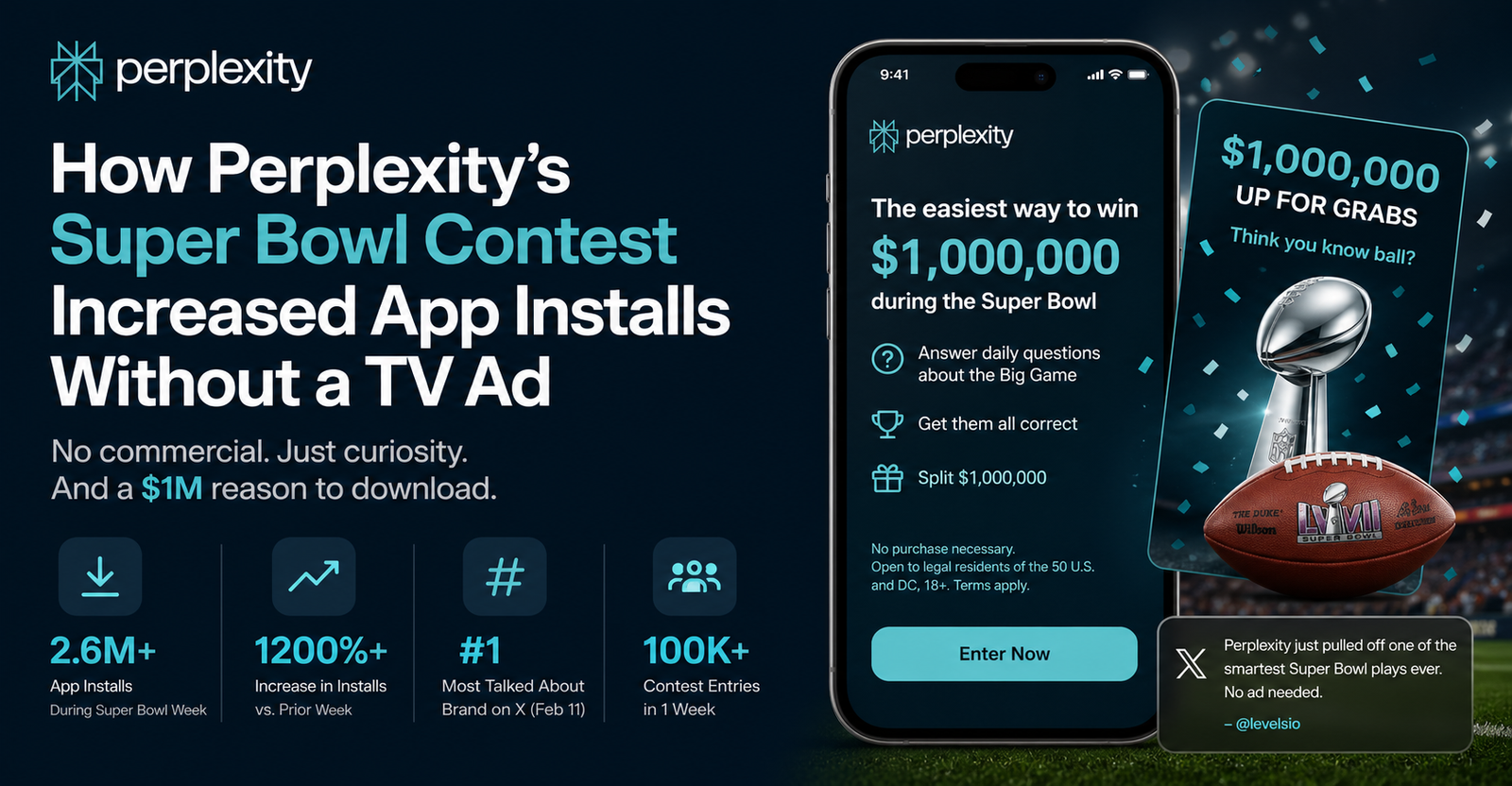
How Perplexity Turned the Super Bowl Into an App Growth Moment
When most brands think about the Super Bowl, they think about huge budgets, celebrity cameos, polished commercials, and a few seconds of national attention. Perplexity took a very different route.
Instead of spending millions on a traditional Super Bowl ad, the AI search company used a simple X post from Aravind Srinivas, its CEO, to launch a $1 million contest. The idea was simple: download the Perplexity app, ask at least five questions during the game, and enter for a chance to win the prize.
That small campaign made a noticeable impact. According to Appfigures data reported by TechCrunch, Perplexity grew from around 30,000 daily downloads to about 45,000 installs on Super Bowl Sunday, marking roughly a 50% increase in app downloads. The app also climbed in the U.S. App Store, reaching as high as No. 6 in the Productivity chart and moving up in the overall app rankings.
What made this campaign interesting was not just the download spike. It was the way Perplexity tied attention directly to product usage.
Why Perplexity Skipped the Traditional Super Bowl Ad
A Super Bowl commercial can create massive visibility, but it is also extremely expensive. For an AI startup, that kind of spend can be risky, especially when the audience may remember the ad but never try the product.
Perplexity avoided that problem by making the campaign action-based. Instead of asking people to watch a commercial, it asked them to use the app.
That difference matters.
A traditional ad usually creates passive awareness. A person sees the brand, maybe remembers the name, and then moves on. Perplexity’s Super Bowl contest pushed people one step further. It gave them a reason to install the app and interact with AI-powered search in real time.
The campaign did not just say, “Look at us.” It said, “Try this right now.”
That is why the campaign worked as more than a promotional stunt. It became a simple form of product-led marketing.
How the Perplexity Super Bowl Contest Worked
The mechanics were easy to understand, which helped the campaign spread quickly.
Users had to:
Download the Perplexity mobile app
Ask at least five questions during the Super Bowl
Enter for a chance to win $1 million
That structure was smart because it removed confusion. People did not need to fill out a long form, watch a full video, or follow a complicated series of steps. They only had to install the app and use it.
The five-question rule was especially important. It meant the campaign was not just chasing empty installs. Perplexity wanted people to experience the product. Asking five questions gave new users a quick feel for how the AI search engine works, how fast it responds, and why it might be useful beyond the contest.
This is where the campaign separated itself from a normal giveaway. A weak giveaway might bring in users who only want the prize. Perplexity built the prize around actual app behavior.
Why Asking Five Questions Was the Smartest Part
The best part of the campaign was not the $1 million prize. It was the requirement to ask questions.
During the Super Bowl, people naturally search for things. They look up player stats, halftime show details, team history, commercials, injuries, records, and random facts that come up during the broadcast. Perplexity placed itself directly inside that behavior.
Instead of trying to pull people away from the game, the app became useful during the game.
That is a strong product fit.
If someone was watching with friends and wanted to know a player’s background, a rule, a stat, or a quick explanation, Perplexity gave them a reason to ask inside the app. The contest simply added motivation.
This created a natural bridge between second-screen behavior and AI search adoption. People were already on their phones. Perplexity just gave them a reason to open its app instead of using a regular search engine.
The App Install Numbers Behind the Campaign
The reported numbers show why the campaign caught attention.
Before the contest, Perplexity was averaging around 30,000 daily downloads. On Super Bowl Sunday, downloads reached about 45,000, based on early App Store estimates from Appfigures reported by TechCrunch. That represented roughly a 50% lift in installs.
The app also gained visibility in the U.S. App Store. It climbed to No. 6 in the Productivity chart and moved from No. 257 to No. 66 in Top Apps Overall, after reportedly peaking at No. 49.
Those numbers are not just vanity metrics. App Store rankings can create a secondary growth loop. When an app rises in the charts, more people discover it. That discovery can bring more downloads, which can push the app higher again.
For Perplexity, the contest gave the app a short-term burst of attention and helped it appear more visible inside the app marketplace.
What Perplexity Did Differently From OpenAI and Google
The timing also mattered because AI companies were becoming more aggressive in mainstream advertising. Big names like OpenAI and Google have the resources to run high-profile brand campaigns, including expensive TV ads.
Perplexity used a different playbook.
Rather than compete on production budget, it competed on behavior. It did not need a cinematic commercial to explain the future of search. It used a contest to make people test that future for themselves.
That gave the campaign a sharper edge. A big ad can tell people what a product does. A good activation campaign lets people feel it.
This is especially important in consumer AI. Many people have heard of AI tools, but they may not know when or why to use them. By asking people to submit five questions, Perplexity lowered that barrier. It helped users move from awareness to actual usage.
Why the Campaign Felt Native to the Moment
The Super Bowl is not just a football game. It is a live cultural event. People watch, react, search, post, joke, compare ads, and check facts in real time.
That made it the right environment for Perplexity’s AI search tool.
The campaign worked because it matched the moment. A search product belongs in a live event where people are curious. A contest belongs in a high-attention environment where people are already engaged. A mobile app belongs in a viewing experience where people constantly use their phones.
This alignment made the campaign feel less forced.
A random contest on an ordinary day might not have created the same effect. During the Super Bowl, users had a reason to ask questions immediately. The campaign turned that live curiosity into app installs, user engagement, and product discovery.
Why This Was More Than a Download Campaign
It is easy to look at the campaign and say Perplexity bought downloads with a prize. But that misses the deeper strategy.
The campaign did three things at once.
First, it created awareness. People saw the X post, heard about the $1 million contest, and connected Perplexity with the Super Bowl conversation.
Second, it drove installs. Users had to download the Perplexity app to participate.
Third, it encouraged activation. Users had to ask five questions, which meant they experienced the core product.
That third part is what made the campaign stronger. Many app campaigns stop at the download. The problem is that installs do not always turn into real users. People often download an app, open it once, and forget about it.
Perplexity reduced that risk by making usage part of the entry process. Even if some users came only for the prize, they still had to test the app before entering.
What Startups Can Learn From Perplexity’s Super Bowl Contest
The biggest lesson is that a startup does not always need to outspend larger competitors. It needs to create a smarter path from attention to action.
Perplexity did not try to match the budget of a major Super Bowl advertiser. It used a simple, timely, high-incentive campaign to drive people into the product.
Startups can learn a few things from this.
A campaign should not only create buzz. It should move users toward the behavior that matters.
A contest should not only collect names. It should help people understand the product.
A live event is more useful when the product naturally fits the way people behave during that event.
A simple campaign can work if the hook is strong, the timing is right, and the user action is easy.
In this case, the action was clear: install Perplexity, ask questions, and enter to win.
The Role of Aravind Srinivas and X
The campaign also showed the value of founder-led communication.
Aravind Srinivas did not need a massive ad rollout to get attention. A direct post on X helped frame the campaign in a casual and fast-moving way. That made it feel more like an internet moment than a corporate campaign.
For a fast-growing AI company, that tone matters. Perplexity is competing in a crowded space where people already know names like ChatGPT, Google Gemini, and OpenAI. A founder-led post can feel more personal and immediate than a polished brand ad.
It also gave the campaign a sense of urgency. People saw the post, understood the rules, and could act right away.
Why the Campaign Matched Perplexity’s Product
Some marketing campaigns get attention but do not connect well with the product. Perplexity’s Super Bowl contest avoided that mistake.
The product is about asking questions and getting answers. The campaign asked people to ask questions and get answers.
That sounds simple, but it is exactly why the idea worked.
The contest did not require users to do something unrelated, like share a random hashtag or watch a promotional video. It made them use the app in the way it was designed to be used.
That is strong product-message fit.
For an AI search engine, the best demonstration is not a slogan. It is a real query. Once users asked five questions, they could judge the product for themselves.
The Bigger Meaning for AI App Marketing
The campaign also points to a wider shift in AI marketing.
As AI tools become more common, brands cannot rely only on big claims. Everyone says their product is smart, fast, useful, or different. Users need to experience the difference.
That is why campaigns built around actual product use may become more important.
For Perplexity, the contest was a way to teach people what the app does without sounding like a tutorial. It turned product education into a game. It made onboarding feel like participation.
That is a smart move in a market where many users are still deciding which AI tools deserve a permanent place on their phones.
Was It a Long-Term Win or a One-Day Spike?
The one question that remains is whether the campaign created lasting users.
A 50% install increase is impressive, but installs are only the first step. The real test is retention. Did users come back after the Super Bowl? Did they keep asking questions? Did they replace some of their normal search behavior with Perplexity?
Those questions matter because app growth is not only about downloads. It is about habits.
Still, the campaign gave Perplexity a strong opening. It brought new users into the app, pushed them to try the core feature, and gave the company a burst of visibility without paying for a traditional Super Bowl commercial.
That is a meaningful win, especially for a company competing against much larger names in AI search.
Why Perplexity’s Super Bowl Contest Worked
Perplexity’s Super Bowl contest worked because it combined the right event, the right incentive, and the right user action.
The Super Bowl gave the campaign attention.
The $1 million prize gave people motivation.
The five-question rule gave users a reason to experience the product.
The X post kept the campaign lightweight and fast.
The result was a growth moment that felt very different from a standard ad. Perplexity did not just ask people to remember its name. It asked them to open the app, ask questions, and see why AI-powered search might be useful.
That is why the campaign is worth studying. It was not only about app installs. It was about turning a live cultural moment into hands-on product discovery.