 By Admin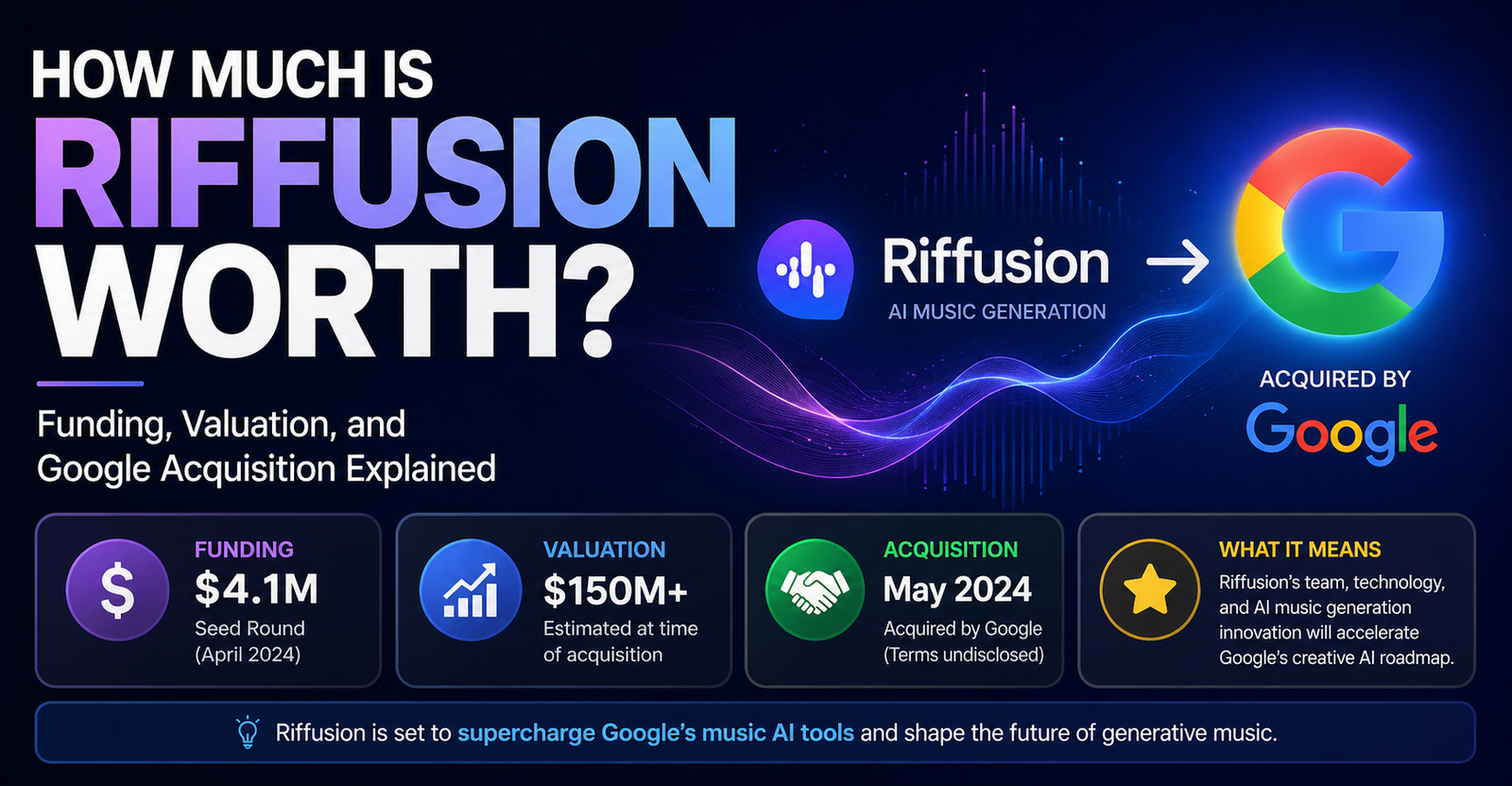
Riffusion became one of the early viral names in AI music. It started as a creative experiment that could turn text prompts into music, then grew into a funded startup, evolved into ProducerAI, and eventually joined Google Labs.
That naturally leads to one question: how much is Riffusion worth?
The honest answer is that Riffusion’s exact valuation was never publicly disclosed. The clearest confirmed number is its $4 million seed round in 2023. Later, ProducerAI, the company that grew out of Riffusion, was acquired by Google, but the deal value was not publicly announced either. TechCrunch reported that Riffusion raised $4 million in seed funding led by Greycroft, with participation from South Park Commons and Sky9.
So, if someone says Riffusion is worth a specific amount, be careful. Public reports confirm funding and acquisition activity, but they do not confirm a final valuation or purchase price.
How Much Is Riffusion Worth?
Riffusion’s exact worth is not publicly known.
The company raised $4 million in seed funding in 2023, but that does not mean the company was worth only $4 million. Funding and valuation are different things. Funding is the amount investors put into the company. Valuation is the agreed value of the company during that investment round.
For example, a startup could raise $4 million at a $20 million, $30 million, or higher valuation, depending on the terms of the deal. Since Riffusion’s private valuation was not disclosed in the main funding reports, the safest answer is this:
Riffusion was valuable enough to raise a $4 million seed round, but its exact private valuation was not made public.
The later Google acquisition likely increased interest in the company’s value, but that price was also not disclosed in public reporting.
Riffusion’s $4 Million Seed Round Explained
The most important confirmed financial detail about Riffusion is its $4 million seed round.
That round was led by Greycroft, with participation from South Park Commons and Sky9. The Chainsmokers were also connected to the company as advisors.
This round mattered because Riffusion had started as a viral project, not as a traditional startup from day one. Its founders saw that people were genuinely excited by the idea of creating music through AI prompts. That attention helped turn a hobby-like experiment into a venture-backed company.
In startup terms, a seed round usually helps a company build its product, hire a team, improve the technology, and test early demand. For Riffusion, the funding gave it room to move from a clever demo into a more serious AI music platform.
Who Founded Riffusion?
Riffusion was founded by Seth Forsgren and Hayk Martiros.
They originally built the project using ideas connected to Stable Diffusion, but instead of generating normal images, the system generated images of sound. These images were spectrograms, which are visual representations of audio.
That made Riffusion unusual. It was not just another chatbot or image generator. It showed that generative AI could create music by working with sound in a visual way.
The project went viral because it felt fresh, strange, and surprisingly fun. Users could type prompts and get short musical outputs. It was not always polished, but it showed where text-to-music tools might go next.
Why Riffusion Became Valuable
Riffusion became valuable because it sat at the center of several fast-growing trends.
First, there was the rise of generative AI. After tools like ChatGPT and image generators became mainstream, investors started looking closely at AI products for every creative field, including music.
Second, AI music had a clear audience. Musicians, producers, content creators, video editors, game developers, and casual users all had reasons to experiment with fast music generation.
Third, Riffusion had viral proof. It was not just an idea on a pitch deck. People had already used it, shared it, and talked about it.
Fourth, the product had room to grow. A simple prompt-based music generator could become a larger music creation platform, with lyrics, vocals, remixing, custom instruments, album art, and eventually music videos.
That is why investors were interested. Riffusion was not only a music toy. It looked like the beginning of a new creative workflow.
Is Riffusion’s Valuation Public?
No, Riffusion’s valuation was not publicly disclosed in the main reports around its seed funding.
This is normal for many private startups. Unless a company or investor shares the valuation, the public often only sees the funding amount. Sites like PitchBook may track private company data, but detailed valuation information is often limited or behind private databases.
This is why it is better to say:
Riffusion raised $4 million in seed funding, but its valuation was not publicly confirmed.
That phrasing is more accurate than guessing.
How Riffusion Became ProducerAI
After its early success, Riffusion later evolved into ProducerAI.
ProducerAI took the basic idea of AI-assisted music creation and turned it into a broader platform. Instead of only generating short musical ideas, it positioned itself as a more complete creative partner for making and refining music.
The platform focused on a more conversational workflow. A user could work with an AI agent, ask for changes, develop sounds, adjust lyrics, remix ideas, and build songs through a back-and-forth process.
That shift matters because the best music is rarely made in one click. Real music creation often involves iteration, taste, revision, and experimentation. ProducerAI tried to make AI music feel more like working with a creative collaborator than pulling a lever and accepting whatever comes out.
Did Google Buy Riffusion?
The clearest way to say it is this: Google acquired ProducerAI, the platform formerly known as Riffusion.
In February 2026, Google announced that ProducerAI was joining Google Labs. Google’s own announcement described ProducerAI as a platform that helps users create and refine music using generative AI.
Music industry reporting described the move as Google acquiring ProducerAI, formerly known as Riffusion, and bringing the startup and team into Google Labs.
So yes, the company that grew out of Riffusion ended up inside Google. But the public reports do not give a confirmed acquisition price.
How Much Did Google Pay for ProducerAI?
The Google deal value was not publicly disclosed.
That means no one outside the company and deal insiders can confidently say how much Google paid for ProducerAI. Some private-market databases list the acquisition date and buyer. For example, PitchBook identifies Google LLC as the acquirer of ProducerAI on February 20, 2026, but the public snippet does not reveal a deal value.
This is important for SEO and accuracy. The article should not invent a number. The most responsible wording is:
Google acquired ProducerAI, formerly known as Riffusion, but the acquisition price was not publicly disclosed.
That answer may feel less exciting than a big headline number, but it is the correct one.
What ProducerAI Does Inside Google Labs
After joining Google Labs, ProducerAI became part of Google’s growing creative AI ecosystem.
Google said ProducerAI helps people create and refine music with generative AI. The platform is built around the idea of helping artists of different skill levels make the music they imagine.
Reporting around the deal says ProducerAI uses Google’s latest AI tools, including Lyria 3 for music generation, Gemini for conversational interaction, Nano Banana for album art, Veo for AI-generated music videos, and SynthID watermarking for AI-generated outputs.
This helps explain why Google would want the company. AI music is not just about songs. It connects to video creation, creator tools, YouTube, social media, gaming, advertising, and the broader future of generative media.
Riffusion vs Suno, Udio, and Other AI Music Startups
Riffusion entered a crowded and fast-moving market.
Other major names in AI music include Suno, Udio, ElevenLabs, and research efforts from companies like Meta and Google DeepMind. Each company approaches music generation differently, but they all compete around the same big idea: making it easier to create music with AI.
Suno and Udio are often discussed as direct AI song generators. ProducerAI appears to lean more into an interactive, agent-like creative process. Instead of simply asking for a song and receiving a finished track, users can refine ideas, workshop lyrics, create instruments, remix songs, and shape the result over time.
That difference matters. In a market full of one-click generators, a tool that feels more like a creative partner may stand out.
Why AI Music Valuations Are Hard to Estimate
AI music startups are hard to value because the market is still young and uncertain.
On one side, the opportunity is huge. Music creation is global. Content creation is growing. Video platforms need music. Creators want fast soundtracks. Brands want custom audio. Independent artists want easier production tools.
On the other side, the risks are real. AI music raises difficult questions about copyright, training data, artist rights, voice cloning, and deepfake music. Music labels, artists, and platforms are still figuring out how to handle AI-generated songs.
That uncertainty affects valuations. Investors may see massive upside, but buyers and startups also have to deal with legal pressure, licensing questions, and public trust.
This is one reason SynthID and watermarking matter. If AI-generated music becomes easier to identify, platforms may have a better way to manage transparency and rights concerns.
Was Riffusion Worth More After the Google Deal?
In practical terms, Riffusion’s perceived value likely increased once it became part of Google.
An acquisition by Google gives the product more credibility, more resources, and access to powerful AI models. It also places ProducerAI inside a much larger ecosystem that includes Google Labs, Gemini, YouTube, Google DeepMind, and other creative AI tools.
But perceived value is not the same as confirmed valuation. Unless Google or the company publicly shares the acquisition price, the exact worth remains unknown.
What we can say is that Riffusion went from viral experiment to funded startup to Google-owned AI music platform in only a few years. That is a meaningful outcome, even without a public deal number.
Final Takeaway
So, how much is Riffusion worth?
The exact number is not public. Riffusion raised a confirmed $4 million seed round in 2023 from investors including Greycroft, South Park Commons, and Sky9. It later evolved into ProducerAI, which was acquired by Google and brought into Google Labs in 2026. However, neither Riffusion’s valuation nor the Google acquisition price has been publicly disclosed.
The safest answer is this: Riffusion was valuable enough to attract seed funding, major music industry attention, and eventually Google’s interest, but its exact worth remains private.
Its real value came from more than one funding round. Riffusion helped prove that AI music could be playful, viral, creative, and commercially interesting. As ProducerAI, it now sits inside one of the biggest AI companies in the world, which makes its story far bigger than a single valuation number.