 By Admin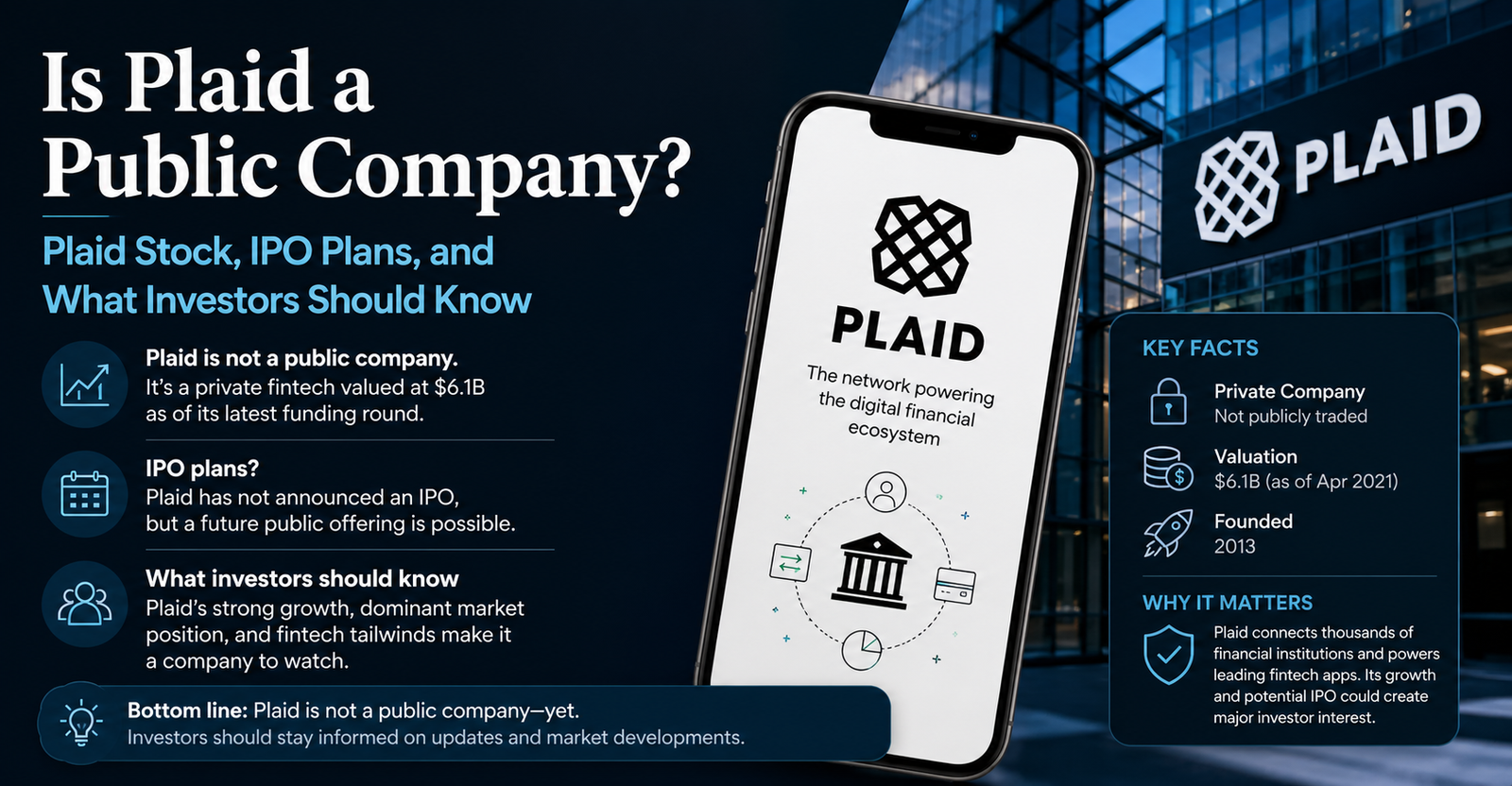
Many investors know Plaid because it sits behind some of the most familiar names in digital finance. If you have ever connected a bank account to a fintech app, payment app, investing platform, lending service, or budgeting tool, there is a good chance you have seen Plaid’s technology in action.
That visibility naturally leads to one big question: is Plaid a public company?
The simple answer is no. Plaid is still a private company, which means it does not trade on the NYSE, Nasdaq, or any other public stock exchange. There is no public Plaid stock price, no official Plaid ticker symbol, and no confirmed Plaid IPO date at the moment. Nasdaq Private Market also states that there is no ticker symbol for Plaid stock because the company remains private and has not completed an IPO.
Still, Plaid remains one of the most closely watched private fintech companies in the world. Its role in open banking, financial data APIs, bank account linking, payments, identity verification, and anti-fraud tools makes it an important company for both fintech founders and investors to follow.
Is Plaid a Public Company?
Plaid is not a public company. It is a privately held financial technology company, so its shares are not available to regular investors through common brokerage platforms.
That means you cannot open a trading app, search for Plaid stock, and buy shares the same way you can with Visa, Mastercard, PayPal, or SoFi. Since Plaid has not gone public, it does not have a public stock quote, public earnings reports, or a stock market ticker.
This is important because many well-known private companies feel public in the minds of consumers. Plaid is widely used across fintech, but public awareness is not the same thing as being publicly traded. A company only becomes public after completing an IPO, direct listing, or another public-market transaction.
For now, Plaid Inc. remains private.
Is Plaid Publicly Traded on the Stock Market?
No, Plaid is not publicly traded on the stock market. It is not listed on the Nasdaq, the NYSE, or any other major public exchange.
This also means there is no official Plaid stock price available to the general public. You may see private-market estimates, valuation reports, or secondary-market interest, but those are not the same as a real-time public stock price. Public stocks trade openly during market hours. Private company shares are much harder to access, less liquid, and usually limited to certain investors.
So if someone is searching for “how to buy Plaid stock,” the honest answer is that most everyday investors cannot buy it right now through standard public markets.
Does Plaid Have a Stock Symbol?
Plaid does not have a stock symbol or ticker symbol.
A stock symbol is usually assigned when a company lists on a public exchange. Since Plaid has not completed an initial public offering, there is no official ticker such as “PLD,” “PLAI,” or anything similar.
This is an easy place for confusion. Some websites may speculate about possible future tickers, but those are only guesses. Until Plaid officially files for an IPO and lists shares on a public exchange, there is no real Plaid ticker symbol.
Can You Buy Plaid Stock Before the IPO?
Most retail investors cannot buy Plaid stock before an IPO. Since Plaid is private, its shares are usually held by founders, employees, early investors, venture capital firms, and institutional backers.
In some cases, private company shares may become available through a secondary market or a pre-IPO marketplace. These markets are usually designed for accredited investors, institutional investors, or approved buyers who meet certain financial and regulatory requirements.
Even when private shares are available, they come with extra risks. They may be hard to sell, difficult to value, and subject to transfer restrictions. A private share price also does not guarantee what the company will be worth if it eventually goes public.
For most everyday investors, the practical answer is simple: they will likely need to wait for a future Plaid IPO before buying shares in the public market.
When Is the Plaid IPO Date?
There is no confirmed Plaid IPO date.
Plaid has been discussed for years as a possible IPO candidate, but the company has not announced an official timeline. In 2025, TechCrunch reported that Plaid raised $575 million at a $6.1 billion valuation and said it would not go public in 2025, although an IPO remained a milestone the company was tracking toward.
More recent reporting in 2026 suggests that Plaid is preparing from a business-readiness perspective, but not rushing into the public markets. The Wall Street Journal reported that CFO Seun Sodipo said the company had earned the right to choose its IPO timing, with annual recurring revenue above $500 million, 40% year-over-year ARR growth, and adjusted EBITDA profitability.
That matters because a strong business can afford to be patient. Instead of going public just because investors expect it, Plaid appears to be waiting for the right mix of internal readiness, market conditions, and long-term strategic timing.
Why Hasn’t Plaid Gone Public Yet?
There are several likely reasons Plaid has not gone public yet.
First, the fintech market has changed. During the 2021 tech boom, private fintech valuations were much higher. Since then, higher interest rates, weaker IPO markets, and more cautious public investors have made it harder for growth-stage fintech companies to list at the valuations they once expected.
Second, Plaid’s valuation has moved with the market. The company was valued at $13.4 billion in 2021, but its 2025 funding round valued it at $6.1 billion. That lower valuation does not automatically mean the business is weak. It reflects a broader reset in private technology and fintech valuations after the low-interest-rate boom.
Third, regulation matters. Plaid operates in areas tied to consumer financial data, open banking, bank connections, payments, and financial privacy. Any company working in those areas has to watch regulatory developments closely. Rules around data access, consumer permission, and bank connectivity can affect how companies like Plaid operate.
Fourth, private funding can give the company more time. A business does not always need to rush into an IPO if it has enough capital, improving revenue, and a path to profitability. For Plaid, staying private gives management more control over timing.
What Does Plaid Do?
At its core, Plaid is a financial data network. It helps people connect their bank accounts and financial data to apps and services they want to use.
For example, when someone connects a bank account to a budgeting app, investment app, payment app, lending platform, or personal finance tool, Plaid may help make that connection happen securely. Plaid says it helps companies build fintech solutions by making it easier and safer for people to connect their financial data to apps and services.
The company is best known for bank account linking, but its business has expanded over time. Today, Plaid is connected to areas such as:
Account verification
Financial data APIs
Payments
Bank payments
Identity verification
Fraud prevention
Credit underwriting
Income verification
Open banking
Open finance
Consumer financial data access
Plaid also says more than 7,000 apps and services are powered by its technology, and that it connects to more than 12,000 financial institutions globally.
That reach is one reason investors keep watching the company. Plaid is not just a consumer-facing fintech brand. It is infrastructure that many other fintech products rely on.
Why Plaid Matters in Fintech
Plaid matters because it helps solve a basic problem in digital finance: how do apps safely connect to bank accounts and financial data?
Before companies like Plaid became widely used, connecting financial accounts to digital apps was often messy, slow, or unreliable. Plaid helped create smoother account-linking experiences for fintech products. That made it easier for consumers to use budgeting tools, payment apps, investing platforms, lending services, crypto apps, and other financial products.
This is why Plaid is often tied to the rise of open banking and open finance. These movements are built around the idea that consumers should be able to securely share their financial data with the apps and services they choose.
For fintech companies, that connectivity can reduce friction. For consumers, it can make financial apps easier to use. For investors, it creates a large infrastructure opportunity.
Who Owns Plaid?
Because Plaid is a private company, its ownership is not as transparent as a public company’s ownership. Public companies file detailed shareholder and financial reports. Private companies do not have to disclose the same level of information.
In general, Plaid is owned by a mix of founders, employees, venture capital firms, and institutional investors. The company was founded by Zach Perret and William Hockey, and it has raised money from several well-known investors over the years.
Reported investors and backers have included NEA, Ribbit Capital, Andreessen Horowitz, Index Ventures, Kleiner Perkins, Fidelity, BlackRock, and Franklin Templeton. In 2025, reports said new investors in Plaid’s funding round included BlackRock, Fidelity, and Franklin Templeton.
This mix of venture and institutional investors shows why Plaid is watched so closely. It sits at the center of fintech infrastructure, but it also has backing from major financial names.
What Happened With the Visa and Plaid Deal?
One major reason Plaid became so widely discussed was its attempted sale to Visa.
In 2020, Visa agreed to acquire Plaid in a deal valued at about $5.3 billion. The deal would have brought Plaid’s financial data network under one of the biggest payments companies in the world.
However, the acquisition did not close. The deal faced antitrust scrutiny from the U.S. Department of Justice, and Visa later abandoned the transaction. The failed acquisition remains a major part of Plaid’s story because it showed how strategically important financial data connectivity had become.
After the deal fell apart, Plaid continued as an independent company. That independence helped keep the possibility of a future Plaid IPO alive.
Plaid Stock vs Public Fintech Stocks
Since Plaid stock is not publicly available, investors who want fintech exposure often look at public alternatives.
These may include companies such as Visa, Mastercard, PayPal, and SoFi. Some investors also look at broader fintech ETFs, which can provide exposure to multiple financial technology companies instead of a single stock.
However, these are not the same as owning Plaid. Visa and Mastercard are global payment networks. PayPal is a digital payments company. SoFi is a consumer finance and banking platform. Plaid is different because it focuses heavily on financial data connectivity and fintech infrastructure.
So while public fintech stocks may give investors exposure to the digital finance market, they do not directly replace Plaid stock.
Quick Plaid Stock Summary
| Question | Answer |
| Is Plaid a public company? | No, Plaid is private |
| Is Plaid publicly traded? | No |
| Does Plaid have a ticker symbol? | No |
| Can retail investors buy Plaid stock? | Not through public exchanges |
| Is there a confirmed Plaid IPO date? | No |
| What industry is Plaid in? | Fintech, open banking, and financial data infrastructure |
| Who founded Plaid? | Zach Perret and William Hockey |
| What does Plaid do? | Helps apps connect to users’ bank accounts and financial data |
Should Investors Watch Plaid Before a Future IPO?
Yes, Plaid is worth watching, especially for investors who follow fintech, payments, and financial infrastructure.
The company operates in a market with long-term demand. Consumers continue to use digital finance apps. Businesses continue to build fintech products. Banks and financial institutions continue to modernize. All of that keeps open banking, financial data APIs, payments, and identity verification relevant.
That said, watching a company is different from being able to invest in it. Plaid is not available to most retail investors right now. There is no public stock, no ticker, and no official IPO date.
For now, the best thing investors can do is follow Plaid’s business performance, funding updates, regulatory developments, and any future IPO filing. If Plaid eventually goes public, it could become one of the more closely watched fintech listings of its cycle.
Final Takeaway
Plaid is not a public company today. It remains a private fintech company, so regular investors cannot buy Plaid stock on the NYSE or Nasdaq. It also does not have a public ticker symbol or confirmed IPO date.
Still, Plaid is an important company in the fintech world. Its technology powers account connections, supports thousands of apps, links to thousands of financial institutions, and plays a growing role in open banking, payments, identity verification, and financial data infrastructure.A future Plaid IPO could attract major attention, but until the company officially files to go public, any date or stock symbol is only speculation. For now, Plaid is a private company worth watching, not a public stock investors can buy today.