 By Admin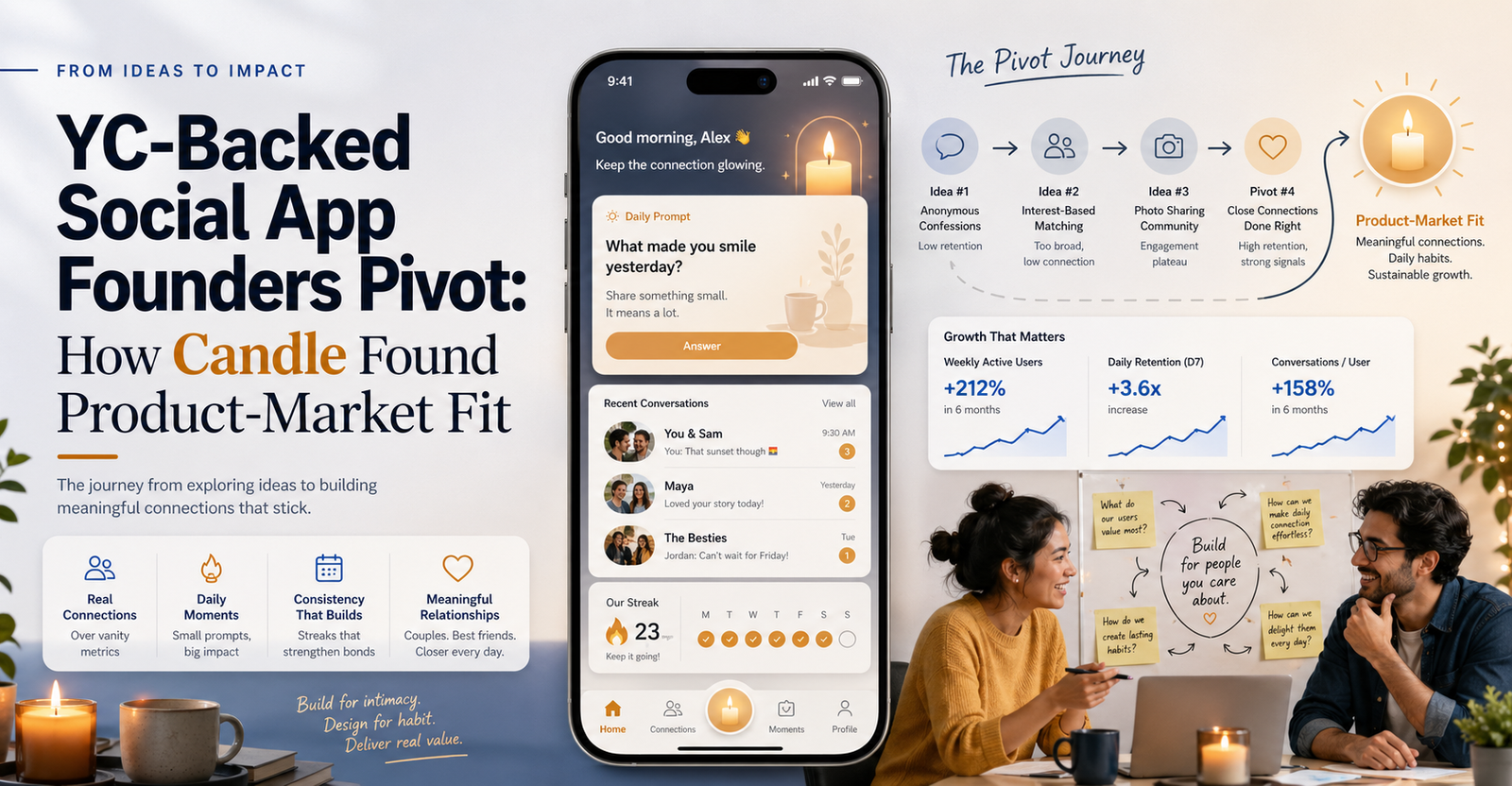
Most startup stories sound clean after they work. A founder spots a problem, builds a product, raises money, launches, and growth follows. Real startup life is usually much messier.
That is what makes Candle interesting. The YC-backed social app did not come from a perfect first idea. Its founders, Alex Ruber and Parth Chopra, entered Y Combinator’s Fall 2024 batch with a different product called Encore, an AI shopping tool. That product did not become the breakout opportunity they wanted, so they kept testing, cutting, rebuilding, and pivoting.
After multiple attempts, they landed on Candle, a lightweight social app for couples and close friends. The product helped users build daily connection through prompts, games, shared moments, and small rituals. Within six months, Candle reached 300,000 users, including 150,000 couples, and crossed more than $1 million ARR, according to TechCrunch.
The story is not just about one app growing quickly. It is about how founders find real traction when they stop protecting the first idea and start listening to the market.
What Is the YC-Backed Social App Pivot Story?
The YC-backed social app founders pivot story refers to the journey behind Candle.
Before Candle, the team was working on Encore, a conversational AI shopping product. The idea made sense on paper. AI shopping was a hot category, consumer apps were attracting attention, and people were already searching for better ways to discover products online.
But a startup does not win because the idea sounds current. It wins when users care enough to come back, pay, share, and build a habit around it.
That was the problem. Encore worked as a product, but the business signals were not strong enough. The founders eventually moved away from the shopping idea and tested several other directions before finding something that clicked.
The eventual winner was simpler than a big AI shopping platform. Candle started as a small relationship-focused game built around questions and daily interaction. It helped people who already cared about each other stay connected.
That narrow focus became its strength.
Who Are the Founders Behind Candle?
Candle was founded by Alex Ruber and Parth Chopra.
According to Y Combinator’s company profile, Alex Ruber is the co-founder and CEO, with previous experience at Apple and NASA JPL. Parth Chopra is the co-founder and CTO, with previous experience at Twitter and Asana.
That background matters because the founders had technical experience, but the breakthrough did not come from technical complexity alone. It came from finding a simple emotional use case.
Many startup teams can build. Fewer can keep changing direction when the product is not working. The difficult part of this story is not that the founders made an app. It is that they were willing to admit when earlier ideas were not pulling hard enough.
What Was Encore Before Candle?
Encore was the earlier product the team brought into Y Combinator. It was an AI shopping tool designed to help people discover and buy products through a conversational interface.
The timing seemed reasonable. AI shopping, secondhand commerce, and personalized discovery were all active startup categories. But the market was crowded. Competing against large platforms like Google Shopping, eBay, and other commerce ecosystems is not easy.
A product can be clever and still not be a great business. That appears to have been the issue with Encore. The founders saw that the economics and market dynamics were not giving them the kind of strong pull they needed.
That is a hard realization for any founder. You can spend months building something, raise money around it, and still have to walk away if the business does not show enough life.
Why Did the Founders Pivot?
The founders pivoted because the earlier direction was not producing the right signals.
In startups, good signals usually look like this:
Users come back without constant pushing.
People share the product naturally.
Retention starts to form.
Revenue appears earlier than expected.
The product solves a real pain, not just a nice-to-have problem.
With Encore, the team did not see enough of those signals. So they did what strong founders often do. They kept testing.
This is where the phrase pivot hell becomes useful. It describes the uncomfortable middle stage where a team is still alive, still capable, and still moving, but has not yet found the idea that truly works.
For Candle’s founders, pivoting was not a branding exercise. It was survival. They needed to find a sharper problem, a clearer audience, and a product loop that people would actually use again and again.
How Candle Started as a Simple Question Game
The first version of Candle was not a huge social network. It was closer to a simple, swipeable questions game.
That simplicity was important. The app gave couples and close friends a reason to pause, answer something, react, laugh, compare, or share a small moment. It did not ask users to build a public profile, chase followers, or broadcast to strangers.
Y Combinator describes Candle as a product that helps couples and friends stay close through short daily rituals that bring back presence, play, and curiosity.
That is a very different kind of social app. Instead of trying to create a new public feed, Candle focuses on existing relationships. The user already has the social graph. The app simply gives that relationship a daily prompt.
That is why the product could feel personal without needing to be complicated.
How Candle Reached 300,000 Users and $1M ARR
Candle’s early growth came from a mix of product simplicity, emotional relevance, and social distribution.
TechCrunch reported that the app reached 300,000 users, including 150,000 couples, within six months of launch. It also had more than 250,000 monthly active users and a DAU/MAU ratio of around 50%, which is a strong engagement signal for a consumer app.
The company also crossed $150,000 in monthly revenue, implying more than $1 million ARR. That matters because consumer social apps often grow first and think about monetization later. Candle showed early willingness to pay, which gave the founders a stronger signal than downloads alone.
The app uses a freemium model. Free users get access to core features such as daily prompts, photo updates, and games. Paid users unlock extra content and premium features.
For a young consumer app, early revenue can be powerful. It suggests users are not only curious. Some find enough value to pay.
Why Candle’s Product-Market Fit Signal Was Strong
Product-market fit is easy to say and hard to prove. For a consumer app, it usually shows up in behavior, not compliments.
People might say they like an app, but the real question is whether they return tomorrow. Do they invite someone? Do they build a streak? Do they pay? Do they feel something is missing if they stop using it?
Candle had several promising signals:
It targeted a clear audience: couples and close friends.
It focused on a real emotional problem: relationships drifting over time.
It created a daily habit through prompts and games.
It had social built in because users needed another person.
It monetized early through premium features.
It spread through social channels like TikTok.
This combination matters. A consumer app needs more than a good interface. It needs a behavior loop. Candle’s loop is simple: open the app, answer or play, share a moment, feel closer, come back tomorrow.
That is why the product worked better than a broader idea. It did not try to be everything. It gave users one small reason to return every day.
Why Private Social Apps Are Getting Attention
Candle fits into a wider trend: people are getting tired of public social performance.
For years, social apps were built around feeds, followers, likes, and public identity. That model still works, but it also creates pressure. Not every interaction needs to be public. Not every connection needs an audience.
Private social apps are different. They focus on small circles, close friends, couples, families, or specific groups. The value is not reach. The value is intimacy.
That is why apps like Candle can feel timely. They are not trying to replace Instagram or TikTok. They are solving a smaller problem: helping people who already know each other stay emotionally connected.
This is also why the product has a better chance of creating habit. A public feed competes for attention. A relationship app connects to someone specific. That makes the reminder feel more personal.
What Founders Can Learn From Candle’s Pivot
The biggest lesson from Candle’s story is that the first idea is not sacred.
Many founders hold onto an idea because they raised money around it, explained it to investors, or spent months building it. But the market does not care how attached you are. It only responds to value.
Here are the clearest lessons from the Candle pivot:
Do not confuse a working product with a good business. Encore may have worked technically, but the economics and market pull were not strong enough.
Follow user behavior, not founder preference. If users naturally return to one product and ignore another, that is valuable information.
Small use cases can become big opportunities. A simple questions game for couples may sound smaller than AI shopping, but it had stronger emotional pull.
Distribution matters. A viral TikTok can create a spike, but the product still needs retention after the spike.
Revenue is a serious signal. Crossing $1 million ARR early gave Candle more proof than vanity metrics alone.
Pivots need speed. The team did not spend years debating. They tested, learned, and moved.
The broader lesson is that startups are not rewarded for being right on day one. They are rewarded for learning faster than they run out of time.
The Risks Candle Still Has to Prove
Even with strong early traction, Candle still has work ahead.
Consumer apps can spike quickly and fade just as fast. A viral moment can bring attention, but long-term success depends on retention. The real question is whether users will still care after 12 months, 24 months, or 36 months.
Candle also has to avoid becoming too crowded. Relationship apps can lose charm if they add too many features. The product works because it feels light, personal, and easy. If it becomes too complex, users may stop seeing it as a daily ritual.
There is also competition. Apps for couples, friendship, journaling, wellness, and private social connection all overlap with parts of Candle’s mission. To keep growing, Candle will need to stay clear about what it does best.
The most important challenge is simple: can it become a real habit, not just a fun early trend?
Why This Story Matters in the YC Ecosystem
Y Combinator is known for pushing founders to move fast, talk to users, and build something people want. The Candle story fits that culture closely.
The founders did not stay locked into the first idea. They kept searching until they found a product with stronger pull. That is one reason startup pivots are so common in the YC world. The goal is not to defend the pitch. The goal is to find the truth.
This is also why Candle’s story is useful for other founders. It shows that pivoting is not always failure. Sometimes it is the path to the real company.
The hard part is knowing when to pivot and when to keep going. In Candle’s case, weak economics and stronger signals elsewhere made the decision clearer.
Final Takeaway
The YC-backed social app founders pivot story is really the story of Candle, a consumer social app that found traction after its founders moved away from an earlier AI shopping tool.
Alex Ruber and Parth Chopra entered Y Combinator with Encore, then tested several ideas before landing on Candle. The product worked because it focused on a simple human problem: couples and close friends want to stay connected, but everyday life makes that easy to neglect.
By turning connection into a daily ritual through prompts, games, streaks, photo updates, and shared moments, Candle found the kind of user behavior founders look for. It grew to 300,000 users, reached strong engagement, and crossed more than $1 million ARR within six months.
The lesson is clear. A startup’s best idea is not always the first one. Sometimes product-market fit comes after several wrong turns, uncomfortable pivots, and a willingness to follow what users actually want.
Most startup stories sound clean after they work. A founder spots a problem, builds a product, raises money, launches, and growth follows. Real startup life is usually much messier.
That is what makes Candle interesting. The YC-backed social app did not come from a perfect first idea. Its founders, Alex Ruber and Parth Chopra, entered Y Combinator’s Fall 2024 batch with a different product called Encore, an AI shopping tool. That product did not become the breakout opportunity they wanted, so they kept testing, cutting, rebuilding, and pivoting.
After multiple attempts, they landed on Candle, a lightweight social app for couples and close friends. The product helped users build daily connection through prompts, games, shared moments, and small rituals. Within six months, Candle reached 300,000 users, including 150,000 couples, and crossed more than $1 million ARR, according to TechCrunch.
The story is not just about one app growing quickly. It is about how founders find real traction when they stop protecting the first idea and start listening to the market.
What Is the YC-Backed Social App Pivot Story?
The YC-backed social app founders pivot story refers to the journey behind Candle.
Before Candle, the team was working on Encore, a conversational AI shopping product. The idea made sense on paper. AI shopping was a hot category, consumer apps were attracting attention, and people were already searching for better ways to discover products online.
But a startup does not win because the idea sounds current. It wins when users care enough to come back, pay, share, and build a habit around it.
That was the problem. Encore worked as a product, but the business signals were not strong enough. The founders eventually moved away from the shopping idea and tested several other directions before finding something that clicked.
The eventual winner was simpler than a big AI shopping platform. Candle started as a small relationship-focused game built around questions and daily interaction. It helped people who already cared about each other stay connected.
That narrow focus became its strength.
Who Are the Founders Behind Candle?
Candle was founded by Alex Ruber and Parth Chopra.
According to Y Combinator’s company profile, Alex Ruber is the co-founder and CEO, with previous experience at Apple and NASA JPL. Parth Chopra is the co-founder and CTO, with previous experience at Twitter and Asana.
That background matters because the founders had technical experience, but the breakthrough did not come from technical complexity alone. It came from finding a simple emotional use case.
Many startup teams can build. Fewer can keep changing direction when the product is not working. The difficult part of this story is not that the founders made an app. It is that they were willing to admit when earlier ideas were not pulling hard enough.
What Was Encore Before Candle?
Encore was the earlier product the team brought into Y Combinator. It was an AI shopping tool designed to help people discover and buy products through a conversational interface.
The timing seemed reasonable. AI shopping, secondhand commerce, and personalized discovery were all active startup categories. But the market was crowded. Competing against large platforms like Google Shopping, eBay, and other commerce ecosystems is not easy.
A product can be clever and still not be a great business. That appears to have been the issue with Encore. The founders saw that the economics and market dynamics were not giving them the kind of strong pull they needed.
That is a hard realization for any founder. You can spend months building something, raise money around it, and still have to walk away if the business does not show enough life.
Why Did the Founders Pivot?
The founders pivoted because the earlier direction was not producing the right signals.
In startups, good signals usually look like this:
Users come back without constant pushing.
People share the product naturally.
Retention starts to form.
Revenue appears earlier than expected.
The product solves a real pain, not just a nice-to-have problem.
With Encore, the team did not see enough of those signals. So they did what strong founders often do. They kept testing.
This is where the phrase pivot hell becomes useful. It describes the uncomfortable middle stage where a team is still alive, still capable, and still moving, but has not yet found the idea that truly works.
For Candle’s founders, pivoting was not a branding exercise. It was survival. They needed to find a sharper problem, a clearer audience, and a product loop that people would actually use again and again.
How Candle Started as a Simple Question Game
The first version of Candle was not a huge social network. It was closer to a simple, swipeable questions game.
That simplicity was important. The app gave couples and close friends a reason to pause, answer something, react, laugh, compare, or share a small moment. It did not ask users to build a public profile, chase followers, or broadcast to strangers.
Y Combinator describes Candle as a product that helps couples and friends stay close through short daily rituals that bring back presence, play, and curiosity.
That is a very different kind of social app. Instead of trying to create a new public feed, Candle focuses on existing relationships. The user already has the social graph. The app simply gives that relationship a daily prompt.
That is why the product could feel personal without needing to be complicated.
How Candle Reached 300,000 Users and $1M ARR
Candle’s early growth came from a mix of product simplicity, emotional relevance, and social distribution.
TechCrunch reported that the app reached 300,000 users, including 150,000 couples, within six months of launch. It also had more than 250,000 monthly active users and a DAU/MAU ratio of around 50%, which is a strong engagement signal for a consumer app.
The company also crossed $150,000 in monthly revenue, implying more than $1 million ARR. That matters because consumer social apps often grow first and think about monetization later. Candle showed early willingness to pay, which gave the founders a stronger signal than downloads alone.
The app uses a freemium model. Free users get access to core features such as daily prompts, photo updates, and games. Paid users unlock extra content and premium features.
For a young consumer app, early revenue can be powerful. It suggests users are not only curious. Some find enough value to pay.
Why Candle’s Product-Market Fit Signal Was Strong
Product-market fit is easy to say and hard to prove. For a consumer app, it usually shows up in behavior, not compliments.
People might say they like an app, but the real question is whether they return tomorrow. Do they invite someone? Do they build a streak? Do they pay? Do they feel something is missing if they stop using it?
Candle had several promising signals:
It targeted a clear audience: couples and close friends.
It focused on a real emotional problem: relationships drifting over time.
It created a daily habit through prompts and games.
It had social built in because users needed another person.
It monetized early through premium features.
It spread through social channels like TikTok.
This combination matters. A consumer app needs more than a good interface. It needs a behavior loop. Candle’s loop is simple: open the app, answer or play, share a moment, feel closer, come back tomorrow.
That is why the product worked better than a broader idea. It did not try to be everything. It gave users one small reason to return every day.
Why Private Social Apps Are Getting Attention
Candle fits into a wider trend: people are getting tired of public social performance.
For years, social apps were built around feeds, followers, likes, and public identity. That model still works, but it also creates pressure. Not every interaction needs to be public. Not every connection needs an audience.
Private social apps are different. They focus on small circles, close friends, couples, families, or specific groups. The value is not reach. The value is intimacy.
That is why apps like Candle can feel timely. They are not trying to replace Instagram or TikTok. They are solving a smaller problem: helping people who already know each other stay emotionally connected.
This is also why the product has a better chance of creating habit. A public feed competes for attention. A relationship app connects to someone specific. That makes the reminder feel more personal.
What Founders Can Learn From Candle’s Pivot
The biggest lesson from Candle’s story is that the first idea is not sacred.
Many founders hold onto an idea because they raised money around it, explained it to investors, or spent months building it. But the market does not care how attached you are. It only responds to value.
Here are the clearest lessons from the Candle pivot:
Do not confuse a working product with a good business. Encore may have worked technically, but the economics and market pull were not strong enough.
Follow user behavior, not founder preference. If users naturally return to one product and ignore another, that is valuable information.
Small use cases can become big opportunities. A simple questions game for couples may sound smaller than AI shopping, but it had stronger emotional pull.
Distribution matters. A viral TikTok can create a spike, but the product still needs retention after the spike.
Revenue is a serious signal. Crossing $1 million ARR early gave Candle more proof than vanity metrics alone.
Pivots need speed. The team did not spend years debating. They tested, learned, and moved.
The broader lesson is that startups are not rewarded for being right on day one. They are rewarded for learning faster than they run out of time.
The Risks Candle Still Has to Prove
Even with strong early traction, Candle still has work ahead.
Consumer apps can spike quickly and fade just as fast. A viral moment can bring attention, but long-term success depends on retention. The real question is whether users will still care after 12 months, 24 months, or 36 months.
Candle also has to avoid becoming too crowded. Relationship apps can lose charm if they add too many features. The product works because it feels light, personal, and easy. If it becomes too complex, users may stop seeing it as a daily ritual.
There is also competition. Apps for couples, friendship, journaling, wellness, and private social connection all overlap with parts of Candle’s mission. To keep growing, Candle will need to stay clear about what it does best.
The most important challenge is simple: can it become a real habit, not just a fun early trend?
Why This Story Matters in the YC Ecosystem
Y Combinator is known for pushing founders to move fast, talk to users, and build something people want. The Candle story fits that culture closely.
The founders did not stay locked into the first idea. They kept searching until they found a product with stronger pull. That is one reason startup pivots are so common in the YC world. The goal is not to defend the pitch. The goal is to find the truth.
This is also why Candle’s story is useful for other founders. It shows that pivoting is not always failure. Sometimes it is the path to the real company.
The hard part is knowing when to pivot and when to keep going. In Candle’s case, weak economics and stronger signals elsewhere made the decision clearer.
Final Takeaway
The YC-backed social app founders pivot story is really the story of Candle, a consumer social app that found traction after its founders moved away from an earlier AI shopping tool.
Alex Ruber and Parth Chopra entered Y Combinator with Encore, then tested several ideas before landing on Candle. The product worked because it focused on a simple human problem: couples and close friends want to stay connected, but everyday life makes that easy to neglect.
By turning connection into a daily ritual through prompts, games, streaks, photo updates, and shared moments, Candle found the kind of user behavior founders look for. It grew to 300,000 users, reached strong engagement, and crossed more than $1 million ARR within six months.
The lesson is clear. A startup’s best idea is not always the first one. Sometimes product-market fit comes after several wrong turns, uncomfortable pivots, and a willingness to follow what users actually want.