 By Admin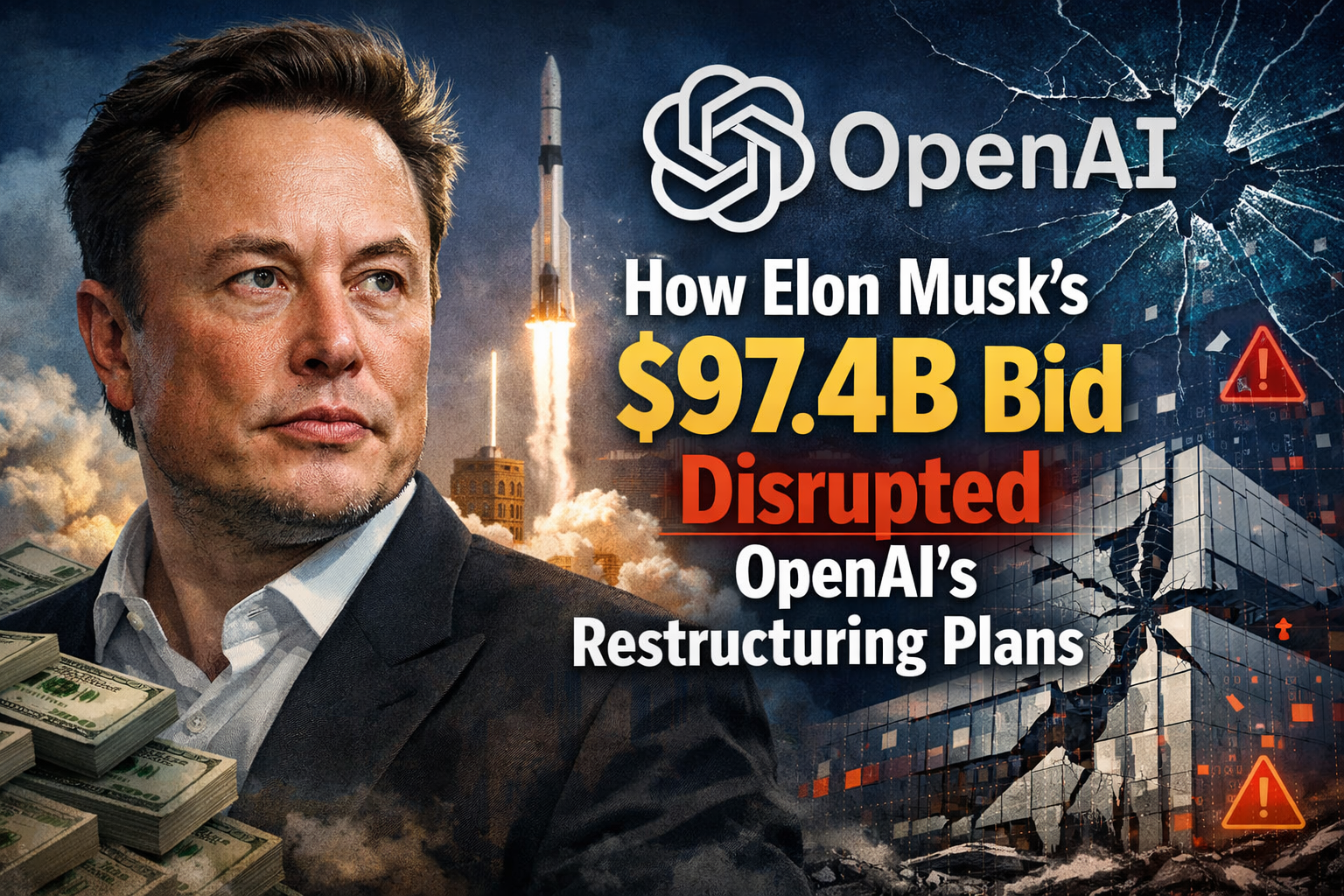
When Elon Musk’s group offered $97.4 billion for control of the nonprofit that sits at the top of OpenAI, it was easy to treat the move like another chapter in the long-running feud between Musk and Sam Altman. But the bigger story was not the drama. It was the timing. OpenAI was already trying to reshape its structure so it could raise much more capital, and Musk’s bid landed right in the middle of that process. That made the offer more than a headline-grabbing attack. It turned it into a real complication for OpenAI’s restructuring plans.
Why the bid mattered so much
The key issue was not just whether OpenAI wanted to sell. It was that the company’s nonprofit parent still had to think like a steward of charitable assets. At the time, OpenAI was working on a transition away from its older capped-profit structure toward a more conventional setup that could support larger fundraising. Legal experts quoted by Reuters said Musk’s bid complicated that process because it raised the question of what the nonprofit’s assets were really worth. If someone was willing to put a number as high as $97.4 billion on control, the board could not casually act as if a much lower internal number was obviously fair.
That is what made the offer disruptive. It did not need to succeed to cause problems. It only needed to create a more difficult valuation and governance environment. TechCrunch framed this clearly in February 2025 when it argued that the bid could “gum up” OpenAI’s conversion because the board had a duty not to undersell the nonprofit’s stake. Once that issue was on the table, every step in the restructuring became harder to defend.
The nonprofit structure became the real battleground
This story only makes sense if you understand the structure fight underneath it. OpenAI began as a nonprofit, then in 2019 created a for-profit subsidiary to help raise capital for research and deployment. Even then, the nonprofit remained in control. By early 2025, OpenAI was trying to evolve again so it could keep attracting the scale of investment needed for advanced AI development. That is why Musk’s challenge focused so heavily on the nonprofit, not just the operating business.
Musk and his allies argued that OpenAI was drifting away from its founding mission and that its charitable assets should not be moved around or diluted without proper protection of the public interest. Reuters reported that Musk’s lawyers even said he would withdraw the bid if the board agreed to preserve the nonprofit mission and halt the move toward a for-profit transition. That made the bid feel less like a pure acquisition attempt and more like a pressure tactic tied directly to the restructuring fight.
Why the board could not just shrug it off
Publicly, OpenAI pushed back fast. Sam Altman dismissed the offer, and the board later rejected it, saying OpenAI was not for sale. But rejection did not erase the problem. The very existence of the bid gave critics, regulators, and courts another reference point for what the nonprofit’s position might be worth. That matters because attorneys general in California and Delaware were already relevant players in reviewing how the nonprofit’s assets and control would be handled.
In practical terms, the bid increased the board’s burden. It had to show not only that the restructuring served OpenAI’s mission, but also that the nonprofit was not giving away value too cheaply in the process. That is where the disruption really happened. Musk did not have to win ownership to make the restructuring more painful. He only had to make the fairness questions harder.
The bid also fed the bigger governance fight
Another reason the offer mattered is that it widened the debate from finance to governance. Soon after the bid was rejected, Reuters reported that OpenAI was weighing special voting rights for its nonprofit board to guard against hostile takeover attempts in the future. That is a strong sign that the company took the threat seriously at a structural level, even if it rejected the specific offer. It suggests the company saw the episode as proof that ordinary capital-raising mechanics were no longer enough protection on their own.
That governance angle is central to the whole episode. OpenAI was not just wrestling with how to raise more money. It was wrestling with how to do that without losing control of its mission, its board authority, or its strategic direction. Musk’s bid sharpened every one of those tensions. It pushed the company to think more carefully about who would ultimately control the future of OpenAI if ever-larger investors came in.
What eventually happened
The full story also matters because the first headline was not the final outcome. In May 2025, OpenAI said it had updated its plans and that the nonprofit would remain in control after discussions with civic leaders and the offices of the attorneys general in California and Delaware. Later, OpenAI explained that its for-profit side would operate as a Public Benefit Corporation, while the nonprofit, later called the OpenAI Foundation, would continue to control it.
That later outcome actually reinforces the point of your title. Musk’s bid disrupted the restructuring not because it stopped OpenAI forever, but because it made the company’s original path harder to follow. The final structure still moved toward a Public Benefit Corporation, but with nonprofit control preserved in a more explicit way. That looks a lot like a restructuring shaped under pressure, not a company gliding smoothly from one model to another. This is an inference from the sequence of events and the later official structure announcements.
Why this fight mattered beyond one deal
The real reason this episode got so much attention is that it exposed a much bigger question inside AI. What happens when a mission-driven nonprofit structure sits on top of one of the most valuable and strategically important companies in the world? OpenAI needed more capital. Musk wanted to challenge the direction of the company. Regulators had to think about charitable purpose. And the board had to weigh all of that while trying to keep control.
So the disruption was never just about a number on an offer sheet. Elon Musk’s $97.4 billion bid complicated OpenAI’s restructuring because it forced the company to answer harder questions about value, mission, fiduciary duty, and governance at exactly the moment it was trying to become more investable. That is why the bid mattered, even after it was rejected. It turned OpenAI’s corporate structure from an internal finance problem into a public power struggle over who gets to shape the future of AI.