 By Admin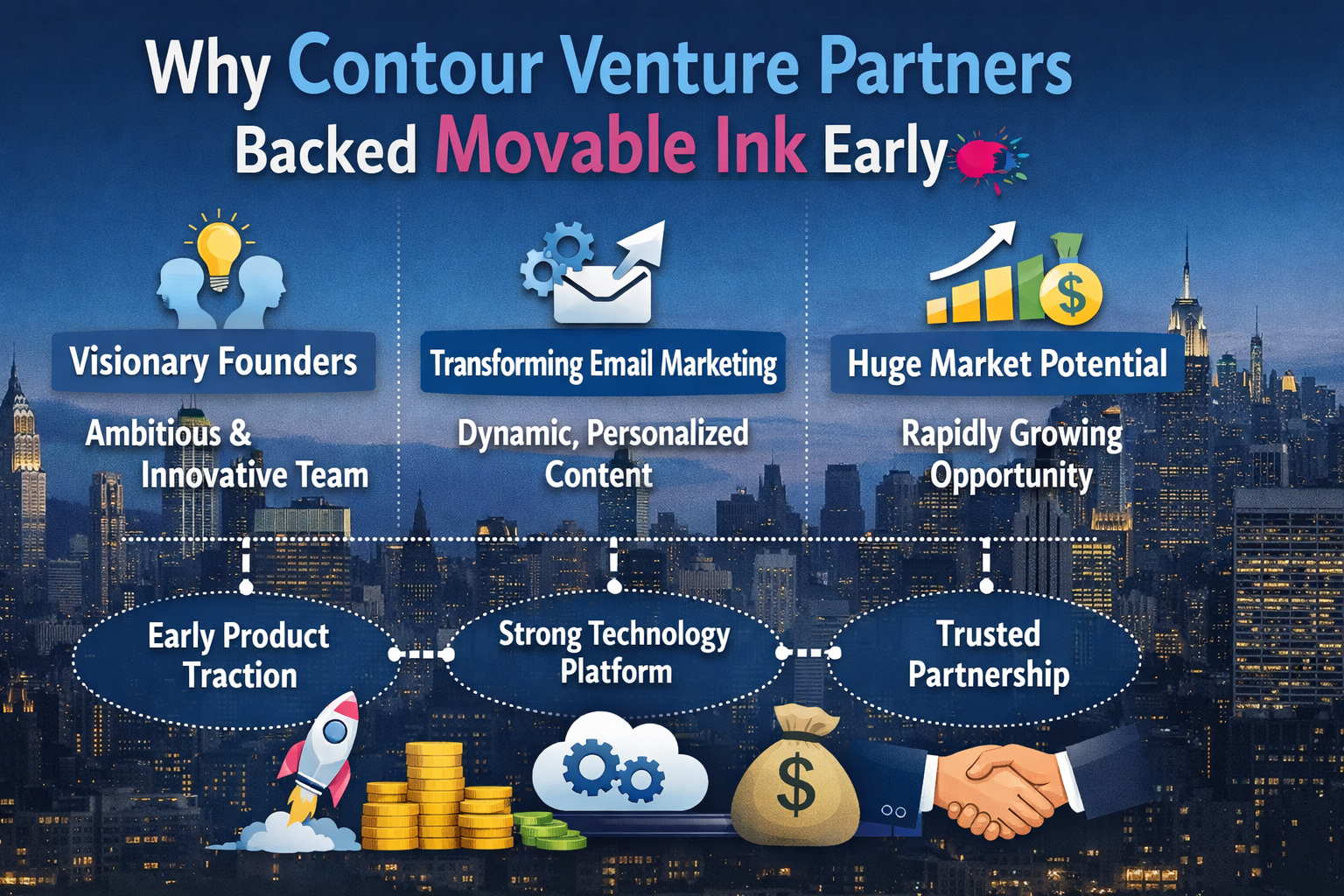
When people search for contour venture partners movable ink investor, they are usually looking for a simple funding connection. But the more interesting story is not just that Contour Venture Partners invested in Movable Ink. It is why that investment made sense so early. Based on Contour Venture Partners’ own investment criteria, its portfolio positioning, and Movable Ink’s later growth, this looks like a classic case of a seed investor spotting a company that fit its thesis almost point for point.
It is also worth being precise here. Contour Venture Partners has not published a detailed public memo laying out every reason it first backed Movable Ink. So the clearest answer comes from matching what Contour says it looks for in a startup with what Movable Ink was building and later became. That gives us a strong, evidence-based explanation without pretending to know private investment discussions.
Contour Venture Partners already had the kind of thesis that Movable Ink fit
Contour Venture Partners describes itself as a New York City based seed-stage venture capital firm founded in 2005. The firm says it focuses on companies providing innovative software solutions in enterprise SaaS, vertical B2B SaaS, and financial services, with a particular focus on New York City and the broader Northeast. Its investment criteria also make the pattern even clearer: it looks for differentiated, defensible, scalable products, significant market share potential in large and growing markets, a clear path to profitability, and the chance to work in deep long-term partnership with management teams. Contour also says it prefers to act as the lead or co-lead investor and often represents the first institutional capital in the company.
That matters because Movable Ink sat right inside that lane. On Contour’s own portfolio page, Movable Ink is described as a New York City company and the first real-time platform for email marketing. The page says the company helps businesses make email campaigns more effective and increase conversions through real-time optimization inside the email itself, including updating content and offers dynamically when the email is opened. That is exactly the sort of software product a seed investor focused on scalable B2B technology would want to see.
Movable Ink was solving a real marketing problem, not a vague one
A lot of early-stage companies sound promising because they describe a broad future. Movable Ink was more compelling because the problem was specific from the start. Brands were already spending heavily on email marketing, but traditional campaigns were often static, slow to adapt, and disconnected from real customer behavior. Movable Ink built around real-time optimization, dynamic content, and later broader content personalization across customer touchpoints. That is a much easier story for an early investor to believe in because the pain point is obvious, the use case is frequent, and the value can be tied to engagement and conversions instead of abstract hype.
From an investor’s point of view, that kind of product has several attractive qualities. It is software-led, it plugs into an existing and valuable business function, and it can become more important as marketing teams chase better performance from the channels they already own. Contour Venture Partners says it wants companies with the potential to achieve meaningful market share in large and growing markets. Email marketing, customer engagement, and personalized content were already important when Movable Ink emerged, and those categories only became more valuable as brands pushed harder toward one-to-one experiences. That likely made Movable Ink look less like a niche tool and more like a company with room to grow into a category leader.
The New York City angle probably helped too
Contour Venture Partners does not hide its geographic preference. It explicitly says it focuses on New York City and the Northeast, where it believes it has an advantage in understanding founders, markets, and industry hubs. Movable Ink was based in New York City, which meant it was not just operating in one of Contour’s preferred sectors, but also in one of its preferred ecosystems. For seed investors, that matters more than people sometimes realize. Geographic proximity can make it easier to build trust, support management teams closely, help with recruiting, and stay active at the board level. Since Contour says board representation and hands-on support are part of its model, Movable Ink’s location likely strengthened the fit.
This is also where Contour’s reputation as an active early-stage partner comes into play. The firm says it helps portfolio companies with recruiting, sales, growth strategies, operations, business development, finance, and exit strategy. It is not hard to see why that would appeal to a company like Movable Ink, which was building in a competitive and fast-evolving marketing technology market. A startup in that position does not just need capital. It needs an investor that understands how to help turn an interesting product into a durable business.
The people behind Contour were used to backing this kind of company
The team context supports the same idea. Matt Gorin, a co-founder and managing partner at Contour Venture Partners, says his focus includes Financial Services, Enterprise SaaS, and B2B Vertical SaaS, and his listed investments include Movable Ink, Datadog, OnDeck, Pendo, and others. TechCrunch also described Contour in 2024 as an early investor in both Datadog and Movable Ink, while noting the firm’s preference for writing checks in seed and early-stage companies, especially in SaaS, digital media, and financial services with a preference for New York and the Northeast. That track record suggests Movable Ink was not an outlier bet. It looked like the sort of business Contour was built to spot.
That is important because good early-stage investing is often about pattern recognition without becoming lazy or repetitive. Movable Ink was not the same company as Datadog or OnDeck, but it did share the qualities Contour repeatedly talks about: a software business, a real commercial use case, a path to scale, and the ability to become deeply embedded in how customers operate. Investors do not just back products. They back products that can grow into habits, workflows, and budgets. Movable Ink clearly had that potential.
Later milestones made the early bet look smart
One reason this investor story keeps showing up in search is that Movable Ink went on to deliver the kind of milestones that validate early conviction. In April 2022, Movable Ink announced a $55 million Series D led by Silver Lake Waterman, reaching a $1.3 billion pre-money valuation. The company said investors in that round included Contour Venture Partners and Intel Capital, and that total capital raised since 2010 had reached $97 million. It also said it had passed $100 million in annual recurring revenue, increased global headcount to 550, and acquired Coherent Path, an AI-powered personalization engine.
Those milestones matter because they reinforce the original logic. A seed investor wants evidence that the product can grow from a sharp initial use case into a bigger platform story. That is exactly what happened here. The company moved from a strong real-time email marketing proposition toward a broader identity built around personalized content, automation, AI, machine learning, and customer experiences across channels. In other words, the market opportunity expanded while the company’s relevance expanded with it. That is one of the best outcomes an early investor can hope for.
The later STG deal adds another layer of validation. Contour’s portfolio page states that in June 2025, private equity firm STG acquired a majority position in Movable Ink. STG described Movable Ink as an AI-powered personalized content platform and said the company had won more than 100 new enterprise customers in the prior year across products including Studio and Da Vinci, while also highlighting its Autonomous Marketing capabilities. That does not tell us why Contour wrote the first check, but it does show the company matured into a serious software asset with strategic value well beyond its original seed-stage profile.
So why did Contour Venture Partners back Movable Ink early?
The simplest answer is that Movable Ink looked like the kind of company Contour Venture Partners was built to back. It was a New York City software company in a market with obvious commercial demand. It offered a differentiated product in email marketing and content personalization. It could tie its value to real business outcomes like engagement and conversions. And it had room to grow from a focused product into a larger martech and enterprise SaaS story. Those are exactly the traits Contour says it looks for in seed and early-stage investments.
A more strategic answer is that Contour likely saw a rare combination of timing, category strength, and company fit. Marketing teams were already under pressure to make digital communication more relevant. Movable Ink was building technology that made that easier in a measurable way. That gave the company a credible route to adoption, expansion, and long-term defensibility. Later funding rounds, unicorn status, and the majority investment from STG did not create the thesis. They simply confirmed that the early read was a strong one.
In the end, the story of Contour Venture Partners and Movable Ink is a useful reminder that the best seed investments often do not look flashy at first. They look aligned. A focused investor with a clear thesis meets a company with a real product, a real market, and a real chance to scale. That is usually where the strongest early bets begin.