 By Admin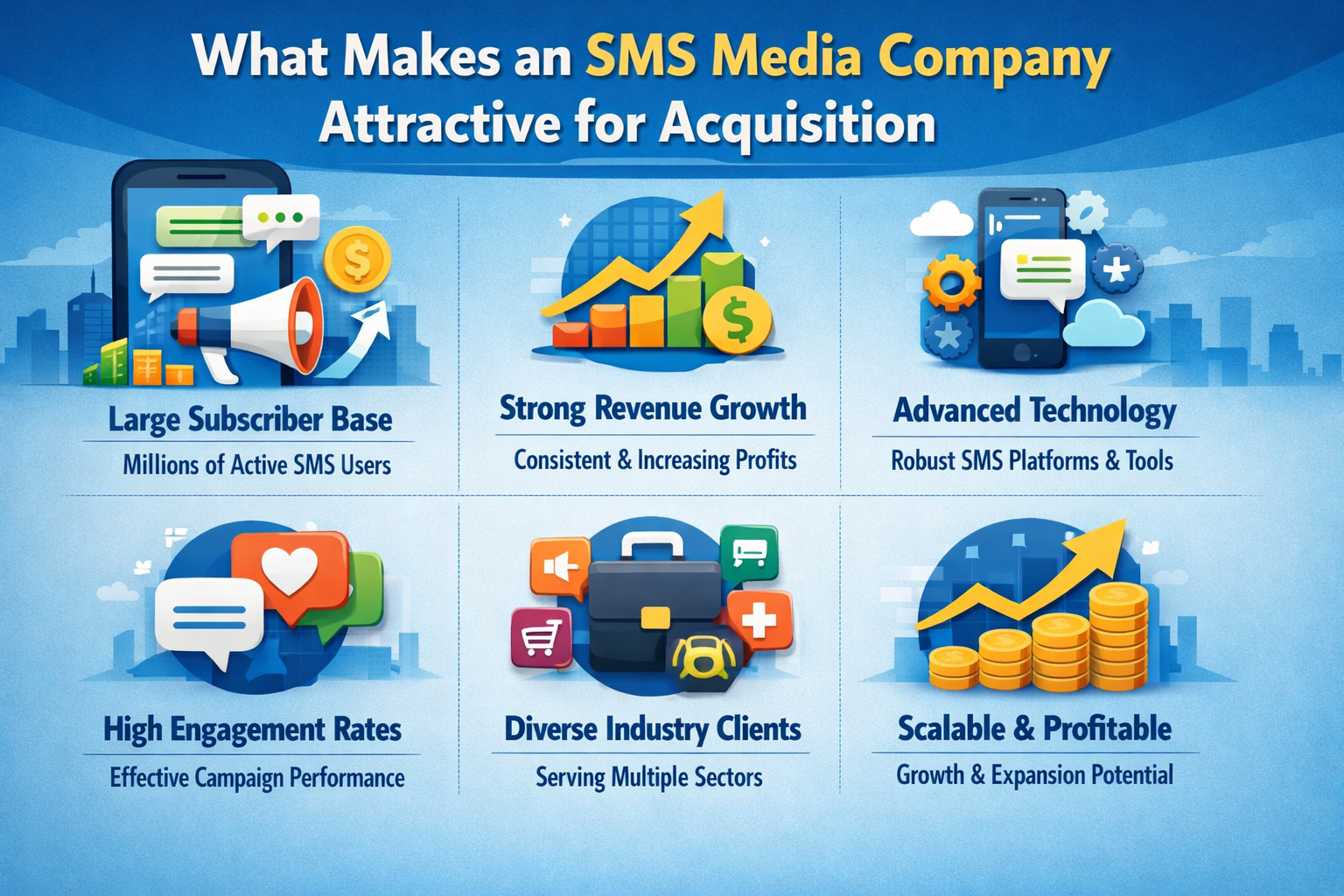
When people search for sms media company acquisition, they are usually not looking for a newspaper or publishing deal. They are looking at the world of business texting, SMS marketing, customer engagement software, and the kinds of messaging platforms that bigger companies want to buy. The clearest example in the search results is the acquisition of MessageMedia by Sinch, along with MessageMedia’s earlier acquisition of SimpleTexting. Together, those deals show what buyers actually value in this space.
The short answer is that an SMS company becomes attractive for acquisition when it is easy to scale, hard to replace, and already embedded in how businesses communicate with customers. Buyers are not just paying for a texting tool. They are paying for a strong customer base, recurring usage, proven infrastructure, self-service growth, and a platform that can open the door to a much bigger customer engagement business. That is the pattern running through the top competitor pages.
Scale is one of the first things buyers look at
An SMS company gets more interesting the moment it can prove real scale. In the case of MessageMedia, that meant serving more than 60,000 customers and handling more than 5 billion mobile messages per year. It also meant meaningful geographic reach across the United States, Australia, New Zealand, and Europe. That kind of footprint changes the conversation from “promising software company” to “serious acquisition target.” It shows that the platform is not just functional, but already trusted at a high volume.
Scale matters because buyers want to reduce risk. A company with tens of thousands of customers and billions of messages has already proven there is market demand. It has also shown that its infrastructure can support real business use cases such as customer relations, alerts, user authentication, and promotional communication. That makes the business more valuable than a newer company that still needs to prove product-market fit.
Strong SMB penetration can make an SMS platform especially valuable
One of the clearest themes across the competitor pages is the importance of the small and medium-sized business market. Sinch explicitly said its acquisition of MessageMedia was about accelerating growth with small and medium-sized businesses, and it described MessageMedia as a leader in mobile messaging solutions for that segment. The company also highlighted the fact that MessageMedia was adding more than 1,500 new customers each month in the United States, which tells you this was not a stagnant customer base. It was still growing fast.
That matters because SMB customers can be incredibly attractive in software if the platform is easy to adopt and efficient to serve. A buyer like Sinch can use that base to expand its addressable market, cross-sell more products, and build a stronger position in customer communications without relying only on large enterprise accounts. Oscar Werner, the CEO of Sinch, said that moving deeper into the SMB segment dramatically expanded the company’s addressable market. That tells you exactly how acquirers think. They want growth, but they want growth that broadens the business strategically.
Easy onboarding and self-service growth raise acquisition appeal
A platform becomes even more attractive when customers can start using it without a long, expensive setup process. Sinch said MessageMedia offered a web-based software-as-a-service suite that made it easy to use two-way messaging without coding or deep familiarity with APIs. It also described the company’s go-to-market motion as being built around digital customer acquisition and online self-service. That is exactly the kind of model buyers like because it supports efficient scaling.
This is a major point in the acquisition story. If an SMS company needs heavy manual implementation for every customer, growth becomes slower and margins come under pressure. But when a platform is easy to deploy, easy to understand, and easy to expand inside a customer account, it becomes far more appealing. Buyers know those products tend to travel well across markets and customer segments. They also know a self-service motion can lower customer acquisition friction and support recurring usage over time.
Product breadth makes the company harder to ignore
An attractive SMS platform is rarely just about sending plain text messages anymore. The top pages around this keyword point toward a broader feature story. TechCrunch noted that MessageMedia offered more than just SMS, including MMS experiences, mobile landing pages, and an API gateway. On the SimpleTexting side, the product positioning includes mass texting, group texting, text blasts, two-way text messaging, autoresponders, scheduled texts, lead generation, text-to-landline, and more.
This matters because buyers are usually looking for platforms, not one-trick products. A broader feature set means more use cases, stronger retention, and more opportunities to move upmarket or deepen account value. It also suggests the company can serve multiple industries and customer needs, from retail promotions to service alerts to ongoing customer support. The more central the product becomes to customer communication, the more attractive it becomes as an acquisition target.
Automation and integrations make the platform stickier
One of the strongest acquisition signals in this category is stickiness. If a customer can connect the messaging platform to the rest of their workflow, they are less likely to leave. That is where automation and integrations start to matter. SimpleTexting emphasizes done-for-you automations and 1,000+ integrations, saying users do not need to build complex flows or write code just to get value from the product.
That kind of capability makes a messaging company more than just a sending tool. It turns the product into part of a larger operating system for marketing, sales, and customer communication. From an acquirer’s point of view, that is powerful. It means customers are not only using the product, they are wiring it into their daily operations. Software that becomes part of the workflow usually commands more interest because it is harder to rip out and easier to monetize over time.
Acquisition history can make a buyer even more confident
Another detail that stands out is that MessageMedia was not just an acquisition target. It had already shown it knew how to use acquisitions to expand. Sinch said MessageMedia’s management team had completed nine successful acquisitions in its target market and had proven its ability to drive consolidation and extract economies of scale. That is a very attractive signal because it tells a buyer the company is not just a product asset. It is also a strategic operator in its category.
You can see that logic in the SimpleTexting deal. Wilson Sonsini said MessageMedia acquired SimpleTexting, a U.S.-based messaging platform with more than 10,000 business customers and annualized revenue of over US$12 million. The deal extended MessageMedia’s North American footprint to more than 20,000 local business customers and helped push more than 25 percent of MessageMedia’s revenue into the United States. That is not a small tactical add-on. It is a clear example of using acquisition to deepen market presence and increase value.
Brand fit and strategic fit matter just as much as raw numbers
A buyer does not make a large acquisition just because a target is growing. The target also has to fit the buyer’s bigger strategy. In this case, Sinch was building a larger cloud communications and mobile customer engagement business. TechCrunch framed the MessageMedia acquisition as part of Sinch’s effort to scale globally and compete more directly with Twilio in business SMS. That makes the acquisition easier to understand. MessageMedia was not random. It strengthened a market where Sinch already wanted to be bigger.
This is one of the most important lessons behind the keyword. An SMS company becomes attractive for acquisition when it fills a strategic gap for the buyer. Maybe it adds SMB reach. Maybe it adds self-service onboarding. Maybe it adds stronger U.S. distribution. Maybe it adds feature depth in SMS marketing, two-way messaging, or customer engagement. In the best deals, the target does several of those things at once. That is when acquisition value starts to rise quickly.
The market also rewards businesses that make texting simple
It is easy to focus only on enterprise scale and forget the practical side of why customers choose these tools. But the competitor pages keep bringing it back to usability. SimpleTexting is built around the idea that texting for business should be simple, flexible, and accessible to companies of all sizes. Its site highlights industries such as restaurants, e-commerce and retail, healthcare, education, real estate, home services, non-profit, government, and marketing agency clients, along with features that let businesses launch campaigns without a lot of technical overhead.
That simplicity matters in M&A because software that is easier to understand usually has a bigger buyer universe and a wider customer universe. It can appeal to the smallest local business and still support bigger organizations that want messaging as part of a larger communication stack. Acquirers are often willing to pay more for products that are both powerful and approachable, because that combination creates room for durable growth.
What really makes an SMS media company attractive for acquisition
When you put all these pages together, the answer becomes pretty clear. An attractive SMS media company is one with scale, a strong SMB footprint, self-service SaaS delivery, broad messaging capabilities, strong automation and integrations, and a product that businesses use again and again. It also helps if the company can support strategic expansion into larger markets or customer segments, and if management has already shown it can execute well through growth and consolidation.
That is why deals like Sinch buying MessageMedia, and MessageMedia buying SimpleTexting, make so much sense. They are not just buying texting software. They are buying customer relationships, recurring activity, scalable infrastructure, and a stronger position in how businesses connect with people every day. In this market, that is what turns an SMS company from useful software into a genuinely valuable acquisition target.