 By Admin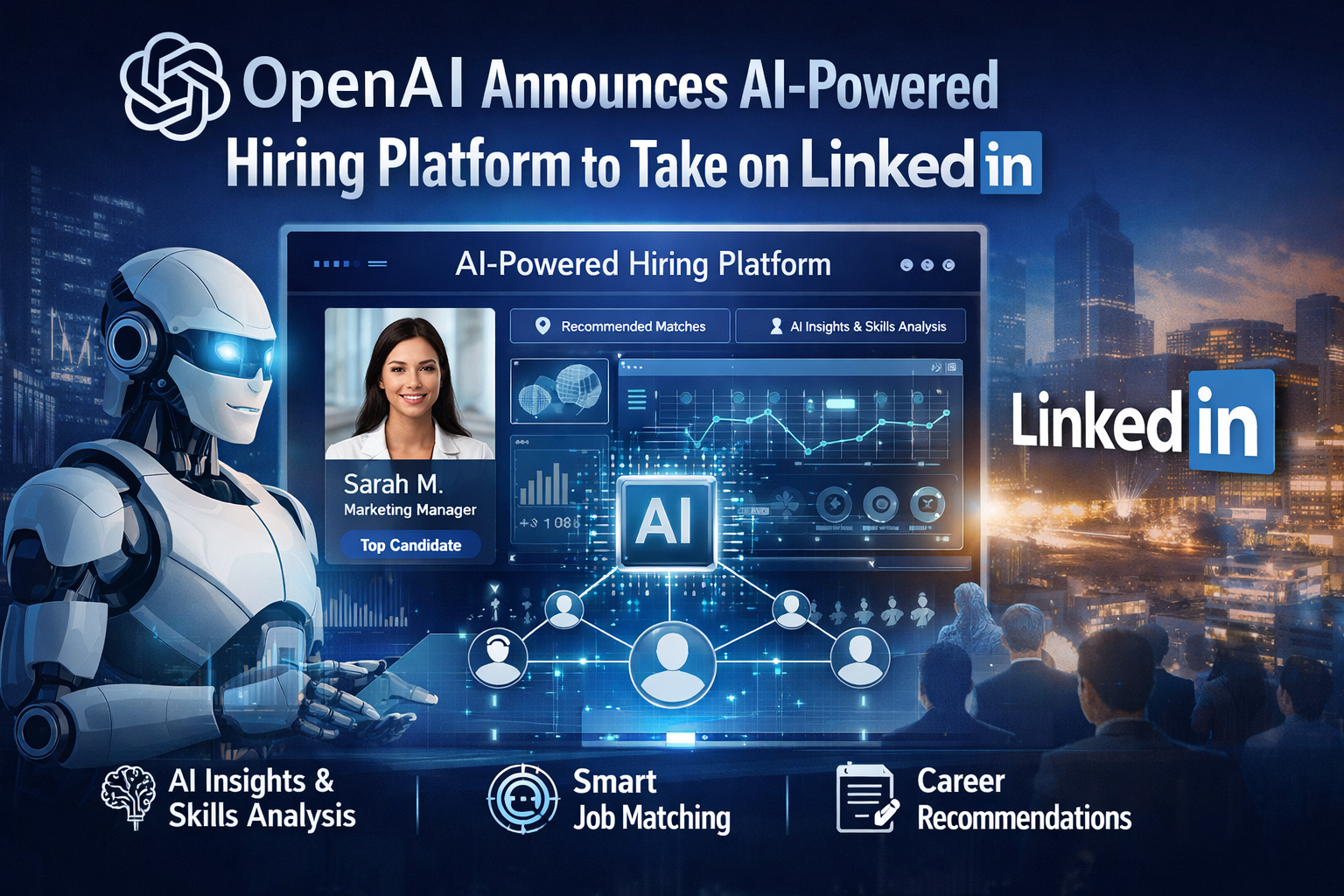
When OpenAI announced it was building an AI-powered hiring platform, the easy headline was obvious: this is a move against LinkedIn. That part is true, but it is also only the surface-level version of the story. What OpenAI is really putting together looks less like a simple jobs board and more like a broader hiring-and-skills system built around AI fluency, employer demand, and matching workers to roles in a more direct way.
According to TechCrunch, the new product is called the OpenAI Jobs Platform, and an OpenAI spokesperson said the company expects to launch it by mid-2026. In Fidji Simo’s official post for OpenAI, she said the platform will use AI to help find “perfect matches” between what businesses need and what workers can offer, while also creating opportunities for people at different skill levels to put their abilities to use.
That instantly makes this a serious LinkedIn story. LinkedIn is still the most recognizable name in online professional networking and hiring, and it is owned by Microsoft, which remains one of OpenAI’s biggest backers. TechCrunch and Investopedia both framed the move as direct competition, especially because LinkedIn has already been adding more AI-powered tools to help match candidates and employers on its own platform.
What OpenAI actually announced
The official OpenAI post is important here because it makes clear that this is not being pitched as just another place to upload a resume. OpenAI says the Jobs Platform is meant to connect businesses looking to hire with people who already have relevant AI skills, while also helping with more task-based needs for companies that may not need a full-time hire. Simo also said the platform will include a dedicated track for local businesses and local governments, which makes the product feel broader than a platform aimed only at big tech employers.
That detail matters because it changes the tone of the announcement. A normal hiring-platform launch usually focuses on employers, candidates, and efficiency. OpenAI is wrapping this one inside a wider message about economic opportunity, workforce readiness, and helping more people learn how to use AI well enough to become more valuable in the labor market.
Why this is bigger than a direct LinkedIn rivalry
The obvious comparison is still useful. LinkedIn has a huge installed base, a deep recruiting footprint, and a long-standing advantage in identity, professional profiles, and employer reach. So if OpenAI wants to compete, it cannot just offer another version of the same thing. It needs a different angle, and that angle seems to be this: instead of centering everything on networking profiles and job posts, it may try to center hiring around demonstrated AI fluency, certifications, and better skill matching for AI-related work.
That is where the announcement gets more interesting. The OpenAI Jobs Platform is being introduced alongside OpenAI Certifications and the expansion of OpenAI Academy. In the company’s own framing, businesses do not just want candidates who say they understand AI. They want people who can actually use these tools productively at work. That turns the platform into something more strategic than a pure recruiting play. It becomes a way for OpenAI to shape how workers prove capability and how employers recognize it.
The hiring platform and the certification push are connected
This is probably the most important part of the whole announcement, and it is also the part many quick rewrites miss. OpenAI says it will expand OpenAI Academy by offering certifications for different levels of AI fluency, from basic workplace AI use up to more advanced areas like AI-custom jobs and prompt engineering. It also says people will be able to prepare through ChatGPT Study mode and get certified without leaving the app.
That means the company is not only trying to help employers find workers. It is also trying to help define what an AI-savvy employee looks like in the first place. If that works, OpenAI gains something much more valuable than traffic. It gains a role in setting the skills language employers use when hiring and the credentials workers use when applying.
The scale of the ambition is also worth noticing. OpenAI says it is committing to certify 10 million Americans by 2030, and it names Walmart as a launch partner in that effort. The company also says it is working with organizations such as John Deere, Boston Consulting Group, Accenture, Indeed, the Texas Association of Business, the Bay Area Council, and the Delaware governor’s office. That is a much bigger ecosystem story than a simple “jobs platform” headline suggests.
What this could mean for employers
For employers, the pitch is fairly easy to understand. Hiring teams are already under pressure to figure out who can actually work effectively with AI and who is mostly using the right buzzwords. If OpenAI can combine a talent platform with recognized certification signals and AI-based matching, it may give employers a more direct way to identify candidates who are already comfortable using modern AI tools.
That does not mean the platform will automatically beat LinkedIn. LinkedIn still has the advantage of scale, brand familiarity, recruiter workflows, and a much more mature employer ecosystem. But OpenAI has something LinkedIn does not: a direct relationship with a massive user base already engaging with ChatGPT, plus the ability to tie hiring to learning, certification, and day-to-day AI tool usage in one connected system. That is why this announcement feels more serious than a random hiring-tech experiment.
What this could mean for job seekers
For workers, the message is both promising and a little unsettling. On one hand, the announcement suggests there may be more structured ways to prove AI fluency and connect that skill to actual job opportunities. On the other hand, it also reinforces a growing reality in the labor market: being comfortable with AI may increasingly move from “nice to have” to “expected,” especially for knowledge work and digital roles.
That fits with the broader future-of-work framing in the announcement. OpenAI openly acknowledges that AI will be disruptive and that jobs will change. TechCrunch also noted that Anthropic CEO Dario Amodei has warned AI could cut deeply into entry-level white-collar work before 2030. OpenAI’s answer is not that disruption will disappear. Its answer is that workers need better access to AI training, skill-building, and new ways to connect with employers who value those skills.
The biggest open question
The strongest version of this story is not pure hype. There is still a real question hanging over all AI-powered hiring tools: can better matching and certification actually improve hiring in a meaningful way, or do they mostly create a smarter-looking version of the same filtering problem? A platform can be excellent at spotting skill patterns and still miss harder human qualities like judgment, curiosity, resilience, leadership, or team fit. That concern is one reason hiring technology always attracts skepticism, even when the product logic sounds strong.
That is especially relevant here because OpenAI is entering a category where trust matters a lot. Recruiters and hiring managers may like the idea of a stronger skills signal, but they are unlikely to hand over the full decision to a model or a certification badge alone. So the long-term success of the OpenAI Jobs Platform will probably depend on whether it feels like a useful hiring layer rather than an attempt to reduce people to AI scores. This paragraph is an inference based on the announced platform, its certification strategy, and the normal limits of hiring technology.
Why this announcement matters
The reason this story is getting attention is not only that OpenAI may be taking on LinkedIn. It is that OpenAI is moving further into the infrastructure of work itself. ChatGPT got the company into everyday workflows. OpenAI Academy and OpenAI Certifications push it into training and skill validation. The OpenAI Jobs Platform extends that into hiring and employer demand. Put together, that looks like a company trying to shape not just how people use AI at work, but how they learn it, prove it, and get hired for it.
So yes, the rivalry angle with LinkedIn is real, and it is the cleanest headline. But the bigger story is that OpenAI seems to be building a full future of work pipeline around AI fluency, hiring, and workforce access. That is why this announcement matters, and that is why it could end up being more significant than a simple platform-vs-platform fight.