 By Admin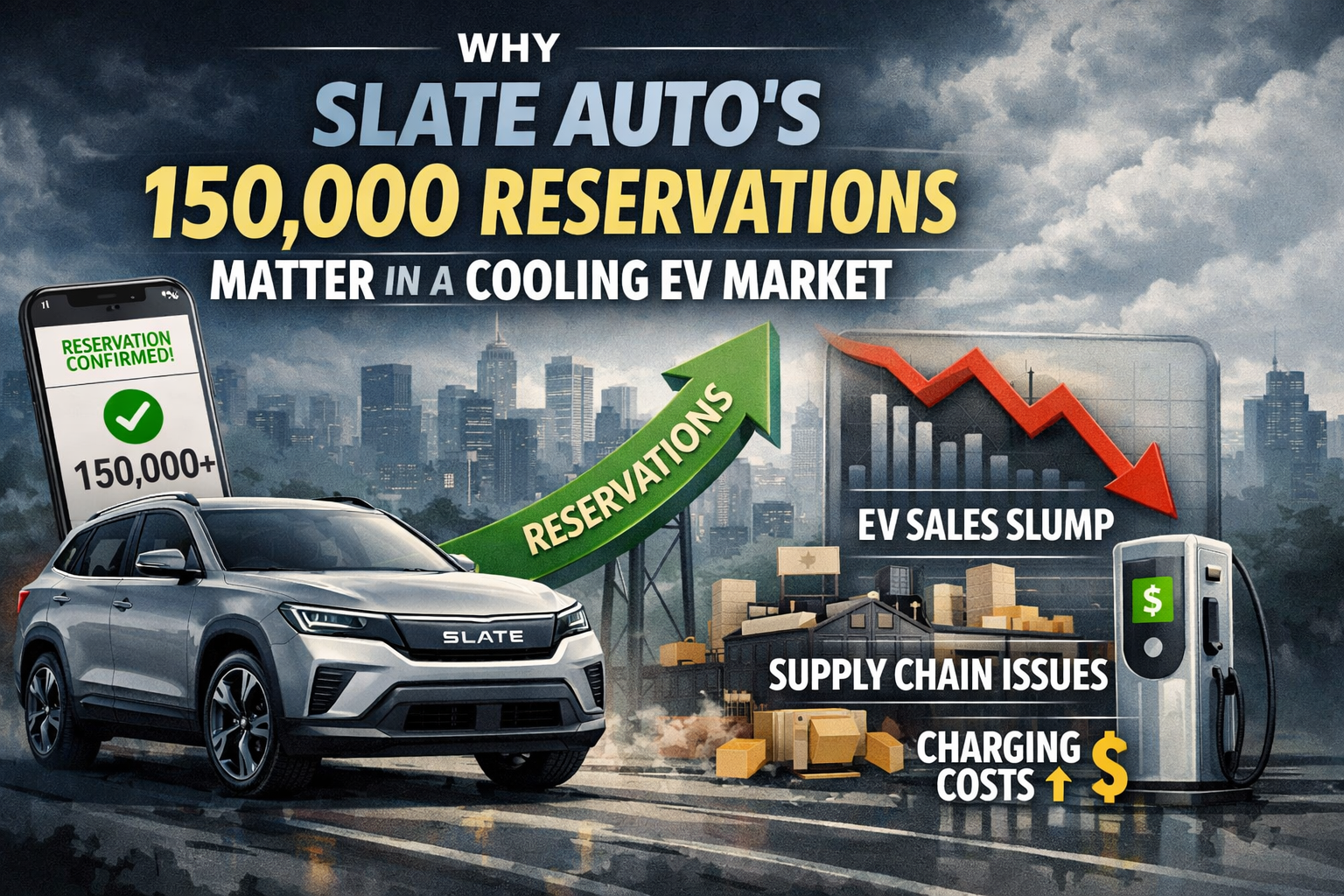
When people see that Slate Auto crossed 150,000 refundable reservations, the easy reaction is to treat it like a flashy headline and move on. But the number matters because of when it arrived and what kind of vehicle it is tied to. Slate is not trying to enter the market with another expensive, feature-loaded electric truck. It is chasing a much harder opening: a lower-cost, more customizable electric pickup aimed at buyers who may have been priced out of the broader EV market. On December 16, 2025, TechCrunch reported that Slate had passed 150,000 refundable reservations for its low-cost vehicle due at the end of 2026.
That headline also matters because reservations are arriving in a market that has become a lot less forgiving. TechCrunch noted that reservations are only a rough measure of interest, not a guarantee of success, because many EV startups have once shown big preorder numbers and later failed when production became difficult or real demand softened. So the real story is not that Slate Auto has already won. It is that it is still attracting meaningful interest while the wider EV truck category looks weaker and more uncertain than it did a few years ago.
The market around Slate Auto is cooler than many people expected
That context is what gives the reservation number weight. In the same December 2025 report, TechCrunch pointed out that Ford had decided to end production of the all-electric F-150 Lightning and replace it with a version that includes a gas generator, while sales of Tesla’s Cybertruck and General Motors’ Silverado EV were also struggling to stay above a few thousand units per quarter. In other words, this is not a moment when every electric truck is automatically attracting strong demand. It is a moment when the category is under pressure.
That is why Slate Auto’s reservation count says something more interesting than simple launch hype. It suggests there may still be real room in the market for a different kind of truck. Instead of trying to beat bigger rivals on spectacle, luxury, or headline technology, Slate is trying to win on a simpler idea: a cheaper, more adaptable vehicle built from the ground up as an EV. TechCrunch explicitly contrasted Slate’s clean-sheet design with the more compromised path taken by rivals that adapted older truck ideas for electric power.
150,000 reservations do not equal 150,000 sales
This is the part that needs to stay honest. A reservation list is useful, but only up to a point. TechCrunch described reservations as a somewhat helpful gauge of general interest, while also warning that they are not proof a startup will successfully get vehicles on the road. That is an important reality check, especially in the EV space, where production delays, weak margins, and funding pressure have damaged more than one promising launch story.
Still, the pace matters. Slate Auto had already surpassed 100,000 refundable $50 reservations by May 12, 2025, just weeks after emerging from stealth. By December 16, 2025, that total had climbed to 150,000 refundable reservations. TechCrunch said that means reservations were continuing to arrive faster than any attrition the company might be seeing. That does not turn reservations into locked-in orders, but it does suggest the interest did not disappear after the first burst of curiosity.
The structure of the offer also helps explain the momentum. On Slate’s own reservation page, the company says $50, fully refundable, locks in a buyer’s place for a blank Slate. The page also tells shoppers they can reserve now and personalize later, when ordering opens. That low-friction setup makes it easier for people to raise their hand, which means the headline number should be read as strong curiosity and real intent, not as guaranteed future deliveries.
Slate Auto is going after a part of the market that still looks open
The strongest reason the reservation milestone matters is that Slate is not chasing the same buyer profile as the most visible electric truck names. According to TechCrunch, the startup came out of stealth in April 2025 focused on an ultra-cheap, customizable electric pickup. The company had been operating for three years in Troy, Michigan, with backing linked to Jeff Bezos, and pitched a business model that stood out in a sector filled with failed launches and broken promises.
That positioning became much clearer at launch. TechCrunch reported that when Slate revealed the truck in Long Beach, California, it said the vehicle would be available for under $20,000 with the $7,500 federal EV tax credit. The base version was described as extremely bare-bones, with about 150 miles of range, no power windows, no main infotainment screen, and not even paint. Later, after the federal credit was set to end, Slate removed the under-$20,000 language from its site, which is an important reminder that affordability claims can shift with policy changes.
Even with that change, the core strategy is still obvious. Slate is trying to build an affordable EV, not a luxury experiment. A separate April 13, 2026 report from DigitalToday, summarizing TechCrunch’s reporting, also highlighted the same low-cost angle and described the base truck as minimalist by design, with buyers expected to lean into customization instead of premium standard features.
Affordability alone is not the whole pitch
The other reason the reservation number matters is that Slate Auto is not selling cheapness by itself. It is pairing affordability with customization. On the official reservation page, Slate says buyers reserve a blank Slate first and pick accessories later. That language is not just branding. It is the center of the company’s sales pitch. The company wants the truck to feel like a starting point that owners shape around their needs rather than a finished product locked into one identity.
That same idea shows up in the launch coverage. TechCrunch reported that before the formal reveal, Slate had already teased concept versions that looked more like SUVs or hatchbacks than pickup trucks. The publication said the company had developed what it called Transformer-like modular capabilities, using public streets to hint at how the vehicle could change form. At launch, TechCrunch also said Slate promised customization down to the number of seats and even the overall silhouette.
That matters in a cooling market because it gives Slate a different emotional hook from most electric truck launches. Many EV startups have tried to sell the future in a broad, almost abstract way. Slate is selling something more grounded: buy a simple truck, then make it yours. For buyers who do not care about luxury badges or giant dashboards but do care about flexibility and price, that message may land better than the usual premium EV playbook. That is an inference, but it fits the product strategy Slate is openly presenting.
The reservations only matter if Slate can build vehicles at scale
This is where the story gets serious. TechCrunch reported that Slate plans to make 150,000 EVs per year at the factory it is refurbishing in Warsaw, Indiana. In the April 2026 timeline piece, the publication also said the company had identified a former 1.4 million-square-foot printing plant in Warsaw as the location for the truck factory. Those are ambitious plans, and they are central to whether the reservation story turns into a real business story.
That scale target makes the reservation figure more meaningful and more demanding at the same time. On one hand, 150,000 reservations looks like a serious sign of market interest. On the other hand, if the company truly wants to produce at that annual level, it will still need to convert reservations into real orders, manage manufacturing, control costs, and deliver vehicles without losing momentum. TechCrunch’s April 2026 article underlined that the road to production is still filled with potential hurdles, even with strong backers and a compelling launch.
That balancing act is exactly why the number matters. It is large enough to suggest Slate Auto is not being ignored, but not large enough to let the company relax. In fact, TechCrunch noted that the company’s next job includes converting the reservation list into as many full orders as possible ahead of its commercial launch. The signal here is not “mission accomplished.” It is “there is something worth chasing if execution holds up.”
What this says about the wider EV market
The reservation milestone also hints at something broader. It suggests the cooling EV market may not be rejecting electric vehicles across the board. It may be rejecting certain kinds of electric vehicles, especially those that are too expensive, too compromised, or too disconnected from what everyday buyers want. TechCrunch argued that with fewer EVs expected to come to the U.S. market and with rivals struggling at the low end, Slate may face very little direct competition in that opening.
If that reading is right, then Slate Auto’s 150,000 reservations matter because they point to a different path for EV adoption. Not every winning electric vehicle story has to start with a luxury badge, a six-figure price, or a giant promise about self-driving. Slate’s own Q&A, cited by TechCrunch, made clear the company is not promising self-driving at all. Instead, it is trying to make a simpler vehicle that feels more accessible and more adaptable. In a market that has started punishing excess, that may be exactly why people are paying attention.
That is the real meaning of the reservation number. Slate Auto’s 150,000 reservations matter not because they guarantee success, but because they show real interest still exists for a cheaper, simpler, more customizable electric pickup at a time when enthusiasm around other EV trucks has cooled. The hard part is still ahead in Warsaw, Indiana. But the market signal is clear enough to matter.